Upper King Street is the stretch of King north of Calhoun Street, and it works differently from the postcard blocks near the Battery. The grid here is newer and the buildings are a mix: a 1920s hotel tower, a 2015 concert hall, a church rebuilt in 1891, and former garages turned into restaurants. For a Charleston Upper King Street walking tour, that mix is the draw. You can read about 180 years of the city's growth just by turning your head.
This self-guided Upper King tour starts on Calhoun Street with the Gaillard Center and Emanuel AME Church, crosses into Marion Square, passes the old Citadel building on Meeting Street, and swings past the Francis Marion Hotel. It then heads north on King to finish with lunch at Leon's Oyster Shop. It is built for food and architecture, so the stops are short and the walking between them is easy, almost all of it on flat sidewalks.
The route was assembled in the Mosey app, which plays historical narration at each stop so you are not reading plaques on a phone screen in the sun. The first three Mosey tours are free. Nothing here requires the app, though; the addresses and notes below are enough to walk it on paper.
The Route: From the Gaillard Center to Leon's on Upper King
"The Gaillard Center reopened in January 2015 after a major rebuild of the 1968 Gaillard Municipal Auditorium, which was named for longtime Charleston mayor J. Palmer Gaillard. The new building kept the site and the civic purpose but replaced the old concrete auditorium with a modern performance hall of roughly 1,800 seats. It is now a main home for touring productions and the Charleston Symphony."
Stand across Calhoun Street to see the full facade; up close it is mostly glass and stone and flattens out. The lobby is open mainly during events, so do not count on getting inside on a weekday afternoon. Check the box office schedule only if you want to add an evening show.
"Emanuel African Methodist Episcopal Church was organized in 1816 and is one of the oldest AME congregations in the South. The Gothic Revival building at 110 Calhoun Street dates to 1891, after earlier structures were lost, and the congregation was tied to Denmark Vesey, who was executed in 1822 after an alleged conspiracy. On June 17, 2015, nine worshippers were killed here in a racially motivated attack."
This is an active church, not an attraction. Be quiet and respectful, keep to the sidewalk, and do not enter during services or expect tours. The memorial tributes and the facade are best seen from the street.
"Marion Square covers about six acres and takes its name from Revolutionary War general Francis Marion. From 1843 until 1922 it served as the parade ground of The Citadel, which is why the square sits beside the old academy building. A Holocaust memorial was added in 2001, and a tall column stands near the Calhoun Street corner; its statue of John C. Calhoun was removed in June 2020, leaving the column bare."
A Saturday farmers market runs here in the warmer months, usually April through November, so a Friday visit gets you a quiet square rather than crowds. Walk the perimeter paths for the best look at the facades along King Street. There is little shade and no restrooms of note, so plan accordingly.
"The state built an arsenal at this site on Meeting Street in 1829, and it became the home of The Citadel when the South Carolina Military Academy was established in 1842. Cadets from the school are credited with firing on the supply ship Star of the West in Charleston Harbor on January 9, 1861, one of the earliest armed acts before the attack on Fort Sumter. The college moved to its current campus on the Ashley River in 1922, and the old building later became a hotel."
Walk the Meeting Street side to see the crenellated towers and stuccoed wall, which are the best features. You can step into the lobby, but there is nothing to pay for or tour. Do not spend longer than ten minutes here.
"The Francis Marion Hotel opened at 387 King Street in 1924 and was named for the Revolutionary War officer nicknamed the Swamp Fox. At twelve stories it was a skyscraper by Charleston standards and became the city's main hotel before the postwar boom. Look at the street level and the upper floors, where the layered masonry and cornice details reflect the 1920s hotel boom in Southern cities."
The lobby is open to the public and worth a quick look at the ceiling and the scale. Directly across King Street stands Hotel Bennett, which opened in 2019, and the contrast between the two is the cleanest architectural comparison on this walk. Skip the hotel bars unless you want a drink; they are not part of the route.
"Leon's Oyster Shop at 698 King Street opened in 2015 in a former auto garage, a good example of how Upper King's utilitarian buildings were repurposed for restaurants after the 2000s revival of the corridor. The corrugated metal walls and garage-style openings keep the working-building look. The menu is built around raw and fried oysters, fried chicken and a soft-serve window."
Go at an off-hour such as 2 p.m. to avoid waiting; weekend lunch and early dinner lines can be long. Order oysters and fried chicken, which is what the place is known for, and expect to pay restaurant prices. The patio is the better seat on a November afternoon.
Planning Notes for Upper King Street
Best time to walk: Mid-November is among the best walking weather Charleston gets: highs typically in the 60s, low humidity, and none of the summer thunderstorm pattern. Mornings can be cool, so bring a light layer. Sunset comes early, around 5:15 to 5:30 p.m., so start by early afternoon if you want daylight for the architecture. In summer, do this walk before 10 a.m. because Marion Square has very little shade.
Shoes: Flat, closed-toe walking shoes are fine. The sidewalks are paved, but King Street's older sections have uneven brick and curb cuts, and the walk is entirely at street level with no stairs. Skip heels and thin soles.
The narration: At each stop, Mosey surfaces the dates, names and documented events behind the building in front of you, from the church's 1816 founding to the hotel's 1924 opening.

Walk Charleston's Upper King Street with Mosey
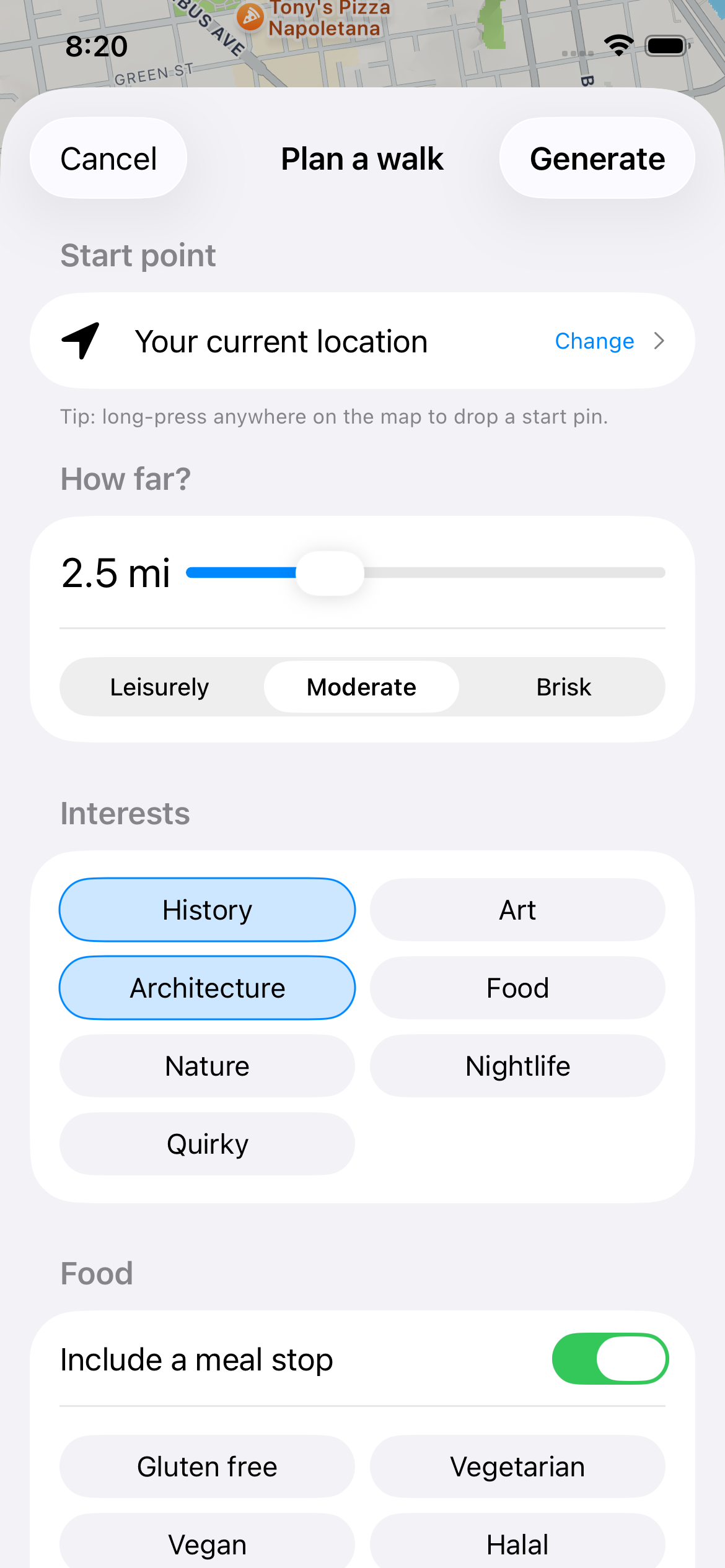
Mosey plans a walk like this one on your iPhone, starting wherever you choose.
- Set a distance or a time and pick what you're into
- Real stops in a walking order that makes sense on foot
- The story behind each stop, read aloud as you arrive
- A meal stop that fits the route

Free to download. iPhone, iOS 17 or later.
Frequently asked questions
How long does it take to walk Upper King Street?
Plan on about two and a half hours for this route, which covers 1.8 miles with six stops. Pure walking time is under an hour. The rest goes to Marion Square, the exterior stops, and a sit-down meal at Leon's Oyster Shop.
Where does Upper King Street start and end?
Upper King Street generally means King Street north of Calhoun Street, running up toward Cannon and beyond. Marion Square sits at the lower edge, and the dining and shopping blocks continue north. This route follows King from Calhoun Street to 698 King.
Is Upper King Street walkable?
Yes, Upper King Street is flat and walkable, with continuous sidewalks and signalized crossings at Calhoun and Cannon Streets. It is a straight line, so there is little risk of getting lost. Expect some uneven brick, and note that the blocks are longer than downtown's lower King.
What is the best time of day to walk Upper King Street?
Late morning or early afternoon is best. Restaurants are open, the light on the facades is good, and Marion Square is quiet on weekdays. In summer, start before 10 a.m. for shade and heat. On Saturdays in season, the farmers market makes the square busy.
Is it safe to walk Upper King Street at night?
Upper King is generally busy and well lit on weekend evenings thanks to restaurants and bars, but it is quieter on weeknights. Stay on King and Meeting Streets, avoid empty side blocks late, and use a rideshare for longer returns. Crowds peak after 9 p.m. on Fridays and Saturdays.
Is Emanuel AME Church open for tours?
Emanuel AME Church is an active place of worship, not a tour site, and visits during services are not appropriate. You can view the 1891 building and memorial tributes from the sidewalk at 110 Calhoun Street. Check the church's own channels for any public events.
More Charleston Walks After Upper King
Once you have finished Upper King, the obvious next walk is lower King Street, from Calhoun down to Broad, where the antiques shops, the Charleston Library Society and the older brick commercial buildings sit. The French Huguenot Church area and the Market district on the east side offer a denser 18th- and 19th-century grid. For a quieter option, the Harleston Village and Ansonborough blocks near the College of Charleston are good for houses and gardens. Mosey can build any of these as a self-guided route with the same stop-by-stop narration.