Charleston has been called the most European city in America, and walking through the lower peninsula you understand why: narrow streets, piazzas instead of front porches, church steeples punctuating every skyline view, and a scale built for people rather than cars. I've walked Charleston twice before without really knowing what I was looking at. The third time I used Mosey — 2.5 miles, History and Architecture filters — and it unlocked the entire city.
The route Mosey built runs from The Battery north through the French Quarter to Waterfront Park, hitting the sites that most casual visitors only half-understand. Having the historical context in my earbuds — hearing that the steeple of St. Michael's Church was used by both British and American forces to aim cannon fire, depending on who controlled the city at the time — made every street feel three-dimensional.
Here's the full route with narration for every stop.
The Route
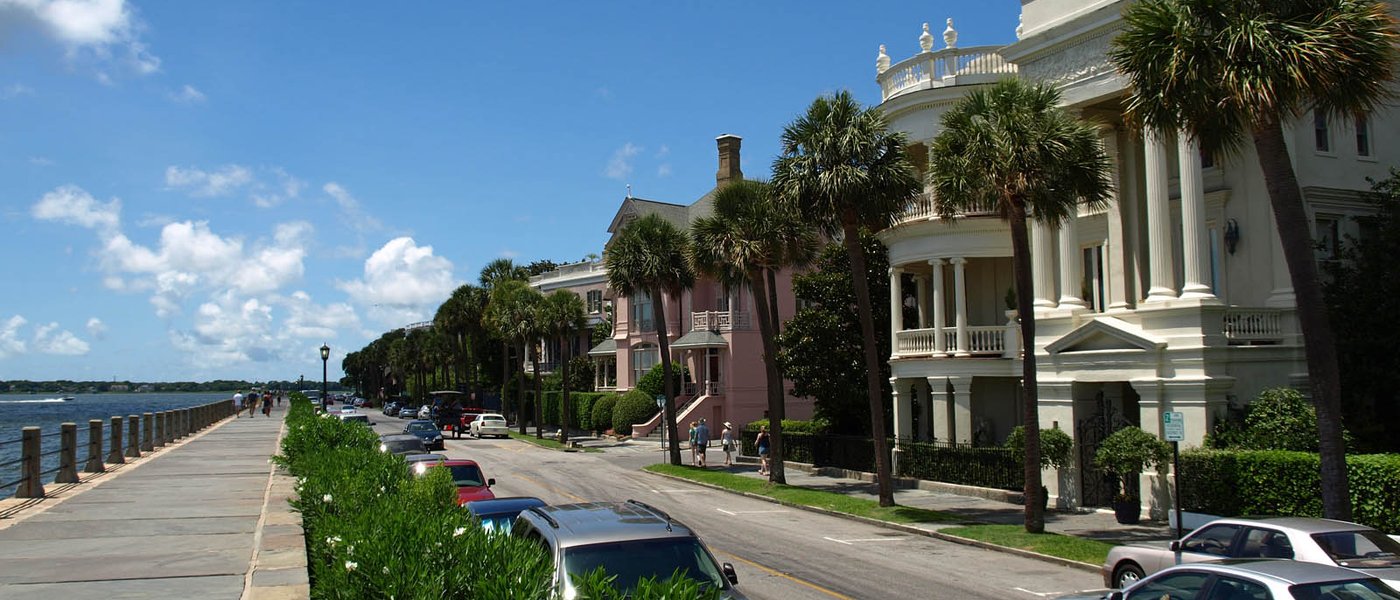
"White Point Garden occupies the southernmost tip of the Charleston Peninsula, where the Ashley and Cooper Rivers converge before flowing into Charleston Harbor. A defensive battery has occupied this point since the 1730s, when it was known as Broughton's Battery. The seawall promenade — 'The Battery' — was reinforced in the 1840s into its current form. On April 12, 1861, residents climbed to rooftops and balconies along East Battery Street to watch as Confederate shore batteries opened fire on Fort Sumter, 3.5 miles across the harbor — beginning the Civil War. The Civil War cannon displayed in the park today are original to the period; some fired on Union warships during the naval bombardments of 1863."
Walk the full promenade from the point north along East Battery Street — the antebellum mansions on your left are some of the finest in America, and the view across the harbor toward Fort Sumter is genuinely moving. The bronze cannons in the park are pointed toward the harbor, still. Several have plaques identifying exactly which engagements they served in.
"Rainbow Row is the longest row of Georgian-style row houses in North America: thirteen pastel-painted buildings stretching along East Bay Street between Tradd and Elliott Streets, numbered 79 through 107. The buildings were constructed between 1740 and 1770 as combined commercial and residential structures — merchants operated ground-floor shops and lived on the upper floors. By the 1920s the row had deteriorated badly. Susan Pringle Frost, a pioneering preservationist, began purchasing and restoring the properties starting in 1931 and painted hers in a Caribbean-inspired pink, starting a neighborhood trend. The current palette of thirteen distinct pastels was established gradually through the mid-20th century and is now considered so historically significant that the City of Charleston regulates the approved colors."
Early morning is the best time to photograph Rainbow Row — the light is ideal and the tourist volume is low enough to get a clean shot. The buildings are private residences; don't knock. Walk slowly and look up: the upper floors have detailed ironwork and shuttered windows that would look at home in Nassau or Havana.
"St. Michael's Church, completed in 1761, is the oldest church building in South Carolina and the city's most prominent landmark. The steeple rises 186 feet and served as a navigational aid for ships entering Charleston Harbor for over a century. During the American Revolution, the British removed the church bells and sent them to England; they were captured by American privateers, returned, damaged in the Civil War, sent back to England for recast, and returned again — a 200-year odyssey. The same steeple was used as an observation post and target for artillery by both British forces (who held Charleston 1780–1782) and Union naval commanders (who bombarded the city from 1863–1865). George Washington worshipped here during his 1791 Southern tour; Robert E. Lee prayed here in 1861."
The church is open for self-guided visits most mornings. Inside, the original box pews from the 18th century are still in use by congregation members whose families have rented the same pews for generations. The graveyard on the south side contains the graves of two signers of the Constitution and the original bells now restored and hanging in the steeple.
"Completed in 1771, the Old Exchange served as Charleston's primary customs house, commercial exchange, and public hall under British colonial rule. In 1788, the South Carolina ratifying convention met here to approve the United States Constitution, making Charleston the eighth state to ratify. The Provost Dungeon beneath the building — a half-subterranean hold dating to a 1680 fortification — held American prisoners during the British occupation from 1780 to 1782, including three signers of the Declaration of Independence: Edward Rutledge, Thomas Heyward Jr., and Arthur Middleton. Today the building is a museum where you can walk the original dungeon floor, see artifacts from the colonial and Revolutionary periods, and stand in the same room where South Carolina voted to join the United States."
Admission is $10. The Provost Dungeon tour is genuinely atmospheric — the walls are original 1680s construction and the ceiling is low. Worth 20 minutes even if you skip the upper floor exhibits. The building also houses what may be the most significant artifact in Charleston: an original portion of the 1718 Half Moon Bastion wall, exposed and visible beneath glass in the dungeon floor.
"The Dock Street Theatre at 135 Church Street stands on the site of the 1736 Dock Street Theatre — the first building in America constructed specifically for theatrical performance. The original theatre burned; the current building incorporates the 1809 Planter's Hotel, which was itself built on the site of the original theatre. The hotel was used as a hospital during the Civil War and deteriorated thereafter. In the 1930s, the Works Progress Administration restored the building as a theatre, adding the distinctive wrought-iron balconies and preserving the hotel's interior features. The theater continues to operate as home to the Charleston Stage company and hosts the Spoleto Festival USA each summer."
The exterior is beautiful even if you don't go in. The wrought-iron balcony on the Church Street facade is among the finest in the city. If you visit during Spoleto Festival season (late May to mid-June), the theatre is programmed nightly; check their schedule in advance.
"Waterfront Park stretches along the Cooper River waterfront between Vendue Range and Cumberland Street, opened in 1990 after a decade of planning and construction on land that had been a working cargo wharf. The park's pineapple fountain — a pineapple was traditionally a symbol of Southern hospitality, placed at gate posts to signal that visitors were welcome — has become one of Charleston's most photographed landmarks. The pier and swings at the park's northern end extend over the Cooper River, offering a view of the Arthur Ravenel Jr. Bridge and, to the south, Fort Sumter on its low-lying island three and a half miles offshore."
The swing chairs on the pier are the best free seats in Charleston — sit, look south toward Fort Sumter, and consider that you can see from here the exact spot where the Civil War started. The park is a good place to end the walk proper before doubling back one block for the meal stop.
"Husk Restaurant occupies an 1893 Queen Anne Victorian house at 76 Queen Street, just two blocks from the French Quarter. Chef Sean Brock opened Husk in 2010 with a singular philosophy: every ingredient on the menu must come from the American South. The menu changes daily based on what farmers and purveyors deliver that morning. The restaurant was named one of the best new restaurants in the country by Bon Appétit in 2011 and has since been recognized as one of the defining restaurants of the modern Southern food movement."
Make a reservation — Husk is consistently one of the hardest tables to get in South Carolina. The bar downstairs takes walk-ins; the burger at the bar is among the best in Charleston. If Husk is fully booked, 167 Raw on East Bay Street is an excellent backup for oysters and fish tacos, and Rodney Scott's BBQ on King Street is legendary smoked whole-hog barbecue.
What to Know Before You Go
Best time to walk: Spring (March–May) before the heavy humidity, or October–November. Charleston summers are hot and extremely humid. The route has minimal shade between The Battery and Rainbow Row; go early if visiting June through September.
The French Quarter: The small neighborhood between Broad Street and Market Street is genuinely the oldest part of Charleston and deserves slow walking. Every alley has something: the Cabbage Row tenement (the real-life setting that inspired DuBose Heyward's Porgy), the Pink House tavern (c. 1712, the oldest surviving tavern building in the South), St. Philip's Church with its graveyard where DuBose Heyward and Edward Rutledge are buried.
Shoes: The streets south of Broad are cobblestone and brick and uneven. Comfortable, closed-toe shoes are essential. No flip-flops.
Generate Your Own Charleston Tour
Mosey builds custom walking tours anywhere — just set your distance and interests. The app routes you through the best stops with narration at every one.
Download on the App Store — FreeMore Charleston Walks to Explore
The Historic District below Broad Street is dense with centuries of history, but the rest of Charleston rewards exploration too. The Cannonborough-Elliotborough neighborhood northwest of downtown has a different scale — smaller houses, community gardens, a concentration of independent restaurants and coffee shops on Cannon Street. Mosey's "Food" filter in that area builds a very different tour: heavier on the chef-driven restaurants that have made Charleston a culinary destination, lighter on the colonial architecture. The North Central neighborhood along Morrison Drive is where the city's industrial heritage lives — old warehouses being converted into breweries and studios — and it's just coming into its own as a walkable destination.