Harvard Square works as a walking tour because four centuries of building sit within a few blocks of each other, and they do not match. A 1720 brick barracks, a 1761 Anglican church, a Victorian memorial hall and a Le Corbusier concrete ramp are all on the same loop. If you care about history and architecture, this Harvard Square walking tour lets you see how Cambridge changed from a Puritan college town into a university campus.
This self-guided Harvard Square tour starts at the old subway kiosk in the middle of the Square. It goes through Harvard Yard, then out along Quincy Street to the Victorian and modernist buildings. From there it turns to the colonial core around Garden Street and the Old Burying Ground, and continues to the Georgian houses of Brattle Street. It finishes with a burger on Massachusetts Avenue. Most of the route is on sidewalks and brick paths, and nearly every stop is free.
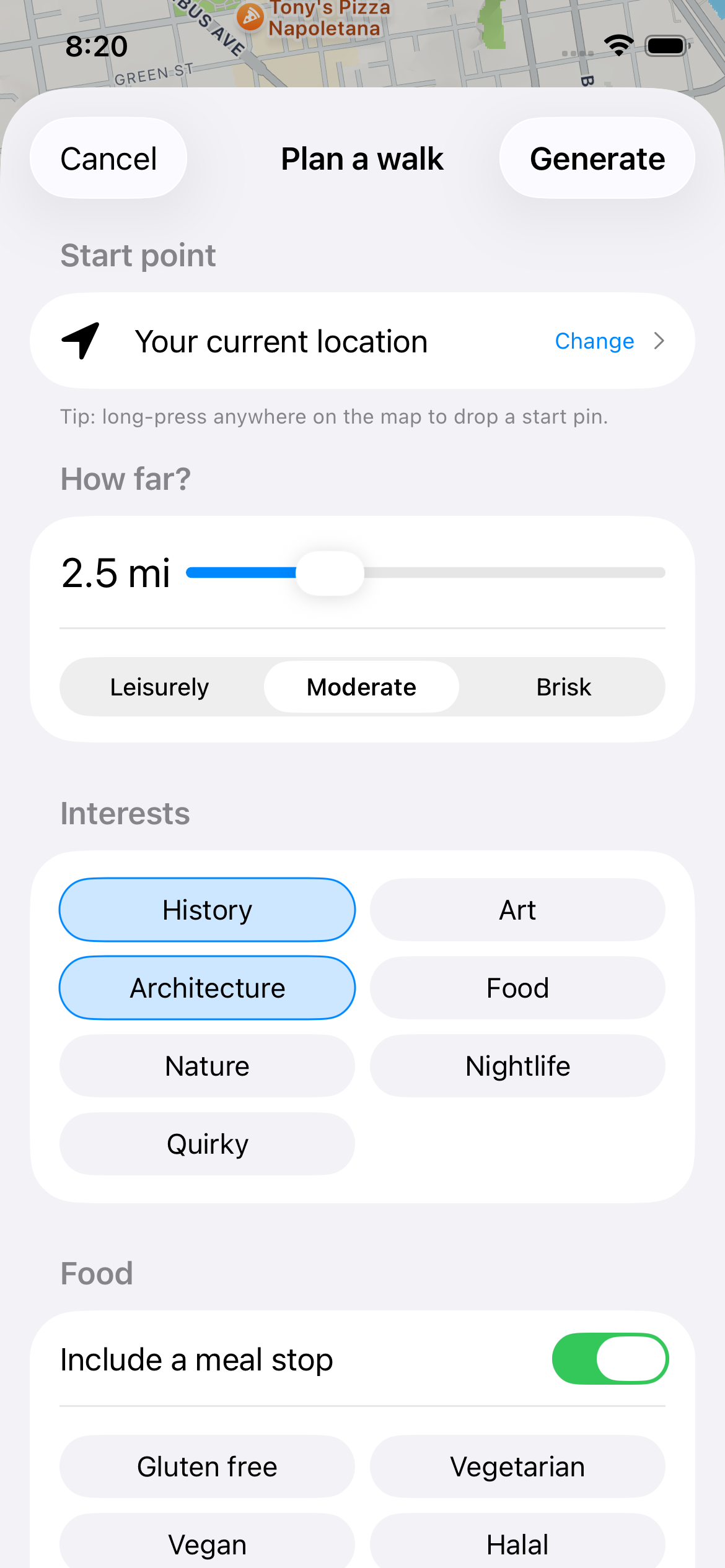
The route was assembled in the Mosey app, which plays short historical narration as you reach each stop. This guide gives you the same background in advance, plus practical notes on what to skip, where to stand and what to check before you go. This walk is planned for Sunday, October 25, 2026, so the notes on Sunday hours and church services matter.
The Route: Brick Yards, a Victorian Memorial and Georgian Houses
"The Red Line's Harvard station opened on March 23, 1912, when the subway's first section ran from Park Street under the Charles River to Cambridge. The glass-and-metal kiosk on the traffic island was built as a subway headhouse in 1928 and later served for decades as a newsstand. Nearby is the Harvard Square Information Kiosk and the plaza where Massachusetts Avenue meets Brattle and JFK Streets, which has been the commercial center of Cambridge since the 1800s."
Start here to get your bearings: the Yard's brick wall and Johnston Gate are directly across Massachusetts Avenue. The Square is busiest on weekend afternoons, with street performers and tour groups. If you want the Yard quiet, start before 10 a.m.
"Harvard was founded in 1636, and Massachusetts Hall (1720) is its oldest surviving building. In 1775 it housed Continental Army soldiers. Johnston Gate (1889) was designed by McKim, Mead & White. Inside, Daniel Chester French's 1884 bronze of John Harvard sits in front of Charles Bulfinch's granite University Hall (1815). Its inscription reads 'John Harvard, Founder, 1638,' which is wrong on both counts: he was a benefactor, not the founder, and the college dates to 1636. Widener Library (1915), by Horace Trumbauer, was given by Eleanor Elkins Widener in memory of her son Harry, who died on the Titanic in 1912."
Enter through Johnston Gate and walk toward the John Harvard statue, then continue to the Widener steps. The Yard is open to the public, free of charge, but Widener's reading rooms are restricted to Harvard ID holders. Skip rubbing the statue's foot for luck; it's a tourist ritual and the line can be long on weekends.
"Memorial Hall, at 45 Quincy Street, honors Harvard men who died fighting for the Union in the Civil War. Its cornerstone was laid in 1870, and it was finished in 1878 to designs by William Robert Ware and Henry Van Brunt, in polychrome Victorian Gothic. The original tower was lost to a fire in 1956, and a replacement was completed decades later. The building holds Sanders Theatre, a wood-paneled auditorium, and Annenberg Hall, the freshman dining hall."
Walk around the exterior to see the banded brick and stone in the transept. The memorial vestibule with the names of the Union dead is sometimes open to visitors, but check before you go, since hours depend on the academic calendar. On a Sunday the building may be closed, so treat the exterior as the main attraction.
"The Carpenter Center at 24 Quincy Street opened in 1963 and is the only building in North America designed by Le Corbusier. Its poured concrete form is built around an S-shaped ramp that rises through the middle of the building, and the structure sits on pilotis, the columns he favored. It stands across the street from the red brick of the Georgian Revival buildings around it, which is a striking contrast, and some people still debate it."
Walk up the ramp for free and look at the brise-soleil (sun-breaker) fins along the facade. The ramp is open to the public, though the galleries inside have their own hours. The concrete is weather-stained in places, so look at it on an overcast day rather than expecting a clean modernist photo.
"The Old Burying Ground, entered from Garden Street beside Massachusetts Avenue, was in use from 1635 into the early 1800s. Henry Dunster, Harvard's first president, is buried there, as are Revolutionary War soldiers and several enslaved people. The slate headstones carry winged skulls, a typical New England mortuary motif. Next to it, the First Parish in Cambridge meetinghouse at 3 Church Street is a stone Gothic Revival building from 1833, designed by Isaiah Rogers."
The cemetery is free and open from dawn to dusk, with a small interpretive sign at the gate. Slate stones are fragile, so don't do gravestone rubbings. The ground is uneven and muddy after rain.
"Christ Church, at Zero Garden Street, was completed in 1761 and designed by Peter Harrison, who also designed King's Chapel in Boston and the Touro Synagogue in Newport. It is a wooden Georgian building. Its Loyalist-leaning congregation fled in 1774, and Continental soldiers were quartered in the church. George and Martha Washington attended a service here on December 31, 1775. Cambridge Common, where Washington's army camped, is right across the street."
The exterior is worth the stop even if the doors are closed. On a Sunday the church holds services, so go inside only for worship or if the building is open for visitors. Afterward, cross to Cambridge Common, which is free, and read the plaque about the army's camp.
"The Georgian house at 105 Brattle Street was built in 1759 for John Vassall, a wealthy Loyalist, on the street later called Tory Row. George Washington used it as his headquarters from July 1775 to April 1776. Henry Wadsworth Longfellow first rented a room in 1837, and Nathan Appleton bought him the house as a wedding gift in 1843. Longfellow lived there until his death in 1882, and the National Park Service now runs it."
The grounds and the formal garden are free and usually open daylight hours. House tours are seasonal and may be limited by late October, so check nps.gov for current hours before you plan around them. The walk along Brattle Street is the best part: look for the wooden Georgian and Victorian houses set back from the road.
"Mr. Bartley's Burger Cottage, at 1246 Massachusetts Avenue, has been a Harvard Square burger place since 1960 and is one of the Square's long-running family businesses. The menu is built around large burgers named after politicians and public figures, with the names updated over the years. The thick onion rings and the frappes are the standard accompaniments. It stands in the commercial stretch of Massachusetts Avenue that grew up along Harvard's southern edge."
Expect a line at lunch and on weekends, and the space is small and cramped. Check Sunday hours before you plan to eat here, since the restaurant has historically had a limited schedule. Burgers are large, and sharing a side of onion rings is enough for two.
Before You Go: Sunday Hours, Weather and What to Skip
Best time to walk: Late October is one of the best times to walk Cambridge. Expect daytime temperatures from the mid-40s to low 60s Fahrenheit, and the trees in Harvard Yard and along Brattle Street are usually at or past peak color. Bring a layer, because wind funnels down Massachusetts Avenue and Garden Street. Rain is common this time of year, and wet brick and fallen leaves are slippery. Daylight ends early, so start by late morning to see the Brattle Street stops in good light.
Shoes: Wear shoes with grip. The route is on pavement, brick walks and a few packed-dirt paths, but Harvard Yard's brick is uneven and wet leaves make it slick. The Old Burying Ground has uneven ground between the gravestones. The Carpenter Center ramp is smooth concrete and slippery in rain.
The narration: At each stop Mosey surfaces the dated, checkable context: who designed the building, when it went up, and what happened there, from the Revolutionary War through the Victorian era to postwar modernism.
Build Your Own Harvard Square Walk
Open the Mosey app to get this route with turn-by-turn directions and narration at each stop, or build a custom version around the buildings you care about most.
Download on the App Store — FreeFrequently asked questions
How long does it take to walk Harvard Square?
Plan for about three hours to walk this 1.8-mile Harvard Square route with stops at eight sites, including a meal. Walking time alone is under an hour. Allow extra time if you tour the Longfellow House, which has seasonal hours, or linger in Harvard Yard.
Is Harvard Yard open to the public?
Yes, Harvard Yard is generally open to visitors, free of charge, though some buildings are limited to Harvard ID holders, including Widener Library. Student-led tours run from the Harvard Information Center in the Smith Campus Center, 1350 Massachusetts Avenue. Check the schedule, as tours vary by season.
What is the best time of year to take a Harvard Square walking tour?
Late September through October is the best time, when temperatures run from the 40s to 60s Fahrenheit and the trees in the Yard and on Brattle Street turn color. Summer is crowded with tour groups, and January winds on Massachusetts Avenue make the walk uncomfortable.
Is Harvard Square walkable without a car?
Yes, it is very walkable. The Red Line stops at Harvard station in the middle of the Square, and the main sights sit on a compact loop of sidewalks and brick paths. Driving is the harder option, since parking is metered and scarce.
Is Harvard Square safe to walk at night?
Harvard Square is generally busy and well lit into the evening, with students, restaurants and the Red Line station nearby. Quieter side streets, the Old Burying Ground and Cambridge Common are less populated after dark, so stick to Massachusetts Avenue and Brattle Street if you are walking late.
More Cambridge and Boston Walks to Build Next
If you want more Cambridge after Harvard Square, Mosey can build a route for Kendall Square and MIT, where the campus holds a strong collection of modern architecture, or for Central Square, which has a much different mix of old industrial buildings and restaurants. Porter Square and Davis Square, both on the Red Line to the north, are good for a lower-key walk with more local shops. Across the Charles River, Beacon Hill and the Back Bay in Boston make a natural second day.