Williamsburg is one of the most visually dense neighborhoods in New York City — every block offers something to look at, whether it's a massive wheat-pasted mural on a warehouse wall, a gallery tucked into a converted factory, or a bakery line that stretches onto the sidewalk. This self-guided Williamsburg walking tour covers the neighborhood's creative core: the Bedford Avenue strip, the waterfront, and the industrial blocks between that have quietly become one of the best outdoor art galleries in the country. If you came for the food and the culture, this route delivers both without wasting a step.
The walk moves from the Bedford Avenue L train stop — the nerve center of Williamsburg life since the neighborhood's creative explosion in the late 1990s — south and west toward the East River waterfront, looping back through the blocks where galleries, murals, and food destinations cluster most densely. Mosey built this route to connect art and food stops that reward slow walking and spontaneous detours. Budget around two and a half hours if you're stopping to eat; closer to ninety minutes if you're keeping pace.
July in Williamsburg means full summer heat bouncing off concrete and warehouse brick, but the waterfront stops on this route catch a reliable breeze off the East River. Start early — before 10am — to beat the Bedford Avenue weekend crowds and catch the murals in morning light before the street fills up. Bring water. The neighborhood has a thousand places to eat but fewer than you'd expect to just sit down and rest in the shade.
The Route: 7 Stops Through Williamsburg's Art & Food Core
"The Bedford Avenue L train stop opened in 1924 as part of the BMT Canarsie Line and remained relatively quiet for decades, serving a working-class neighborhood of Eastern European and Puerto Rican families. The demographic shift began accelerating in the late 1990s as artists priced out of Manhattan crossed under the East River looking for cheap studio space. By the early 2000s, Bedford Avenue had become a shorthand in the national press for a particular kind of urban bohemia — independent record stores, vintage shops, and coffee shops with no Wi-Fi passwords. The 2019 Amazon HQ2 debate and subsequent L train shutdown scare (the full closure was ultimately avoided) underscored just how central this single subway stop had become to the neighborhood's identity."
Stand at the corner of Bedford and North 7th and look south down the avenue — this is the view that launched a thousand think-pieces about gentrification. The stretch of Bedford between North 7th and North 4th is still one of the best blocks for window-shopping and people-watching in Brooklyn. Don't rush through it.
"McCarren Park spans 35 acres straddling the Williamsburg-Greenpoint border and has been a neighborhood anchor since it was established in 1906, named for Patrick McCarren, a Brooklyn political boss who served in the state senate. The park's historic bathhouse — a grand Beaux Arts structure built in 1936 through the Works Progress Administration — served as an indoor swimming facility for decades before closing in 1984. After years as a music venue hosting massive summer concerts, the bathhouse was restored and reopened as a public pool in 2012, completing a $50 million renovation. The park's ball fields and track have long been central to the neighborhood's Dominican and Puerto Rican communities and remain in constant use year-round."
In July, the McCarren Park Pool is open to the public and free with a NYC Parks permit — if you want to cool off mid-walk, this is your moment. Even if you skip the pool, walk through the park's interior rather than around the perimeter: the tree canopy makes it noticeably cooler than the surrounding streets.
"The blocks between the BQE and the waterfront — particularly along Kent Avenue and the cross streets running toward Grand — became an unofficial outdoor gallery over roughly two decades of incremental wall-by-wall commissioning. Artists including Shepard Fairey, Swoon, and dozens of international muralists have painted on these warehouse exteriors, making the corridor one of the densest concentrations of large-format street art in New York. The Index Art Center and local organizations like Welling Court have helped formalize what began as unauthorized wheat-pasting in the early 2000s. Many of the largest walls are re-commissioned every few years, meaning the specific works change but the density remains constant."
Walk Kent Avenue with your eyes up — the scale of these murals only registers once you step back into the street. The best light for photography is before 11am when the sun hits the west-facing walls. You don't need to know the artists to appreciate what's here, but a quick search of 'Williamsburg mural map' before your walk will tell you what's currently installed.
"The site of the Domino Sugar Refinery is one of the most historically significant industrial parcels in Brooklyn. The refinery, which opened in 1856 and was operated by the American Sugar Refining Company (later Domino Foods), processed roughly half of the nation's sugar supply at its peak output in the early 20th century. The facility employed thousands of Williamsburg residents — including large numbers of Polish, Italian, and later Puerto Rican workers — until it closed in 2004 after 148 years of operation. The iconic brick refinery building with its landmark 'Domino Sugar' sign was preserved as part of a mixed-use redevelopment; the surrounding land opened as Domino Park in 2018, designed by landscape architecture firm James Corner Field Operations, the same firm behind the High Line."
The park's waterfront promenade offers a direct view of the Manhattan skyline and the Williamsburg Bridge — one of the best unobstructed views in Brooklyn. Look for the preserved industrial artifacts embedded in the park design: refinery equipment, bone char filters, and pan covers are displayed along the walkway as sculptural relics. Entry is free and the park runs daily until 10pm.
"The Williamsburg Bridge opened on December 19, 1903, becoming the longest suspension bridge in the world at the time and immediately outpacing the Brooklyn Bridge in daily crossings. It was instrumental in the mass migration of Jewish immigrants out of Manhattan's Lower East Side into Williamsburg, which became the largest Jewish community in America by the 1920s. The bridge's steel towers — a departure from the Brooklyn Bridge's stone Gothic arches — were a deliberate engineering choice reflecting the industrial pragmatism of the era. The Williamsburg Bridge was nearly demolished in the 1980s when inspectors found severe structural deterioration; a $800 million rehabilitation completed in the early 2000s saved it."
From River Street at the base of the bridge anchorage, you get a dramatic low-angle view of the bridge's steel superstructure. The pedestrian and bike path on the south side of the bridge is free and open — if you have extra time, even walking a few hundred feet onto the span gives you a perspective on both waterfronts that's hard to match anywhere else in the city.
"Marlow & Sons opened in 2004 on Broadway in Williamsburg, part of the Andrew Tarlow restaurant group that also includes Diner and Roman's. It helped define a particular Brooklyn aesthetic — reclaimed wood, no reservations, a menu built around local sourcing and seasonal ingredients — that became enormously influential on American restaurant culture in the following decade. Tarlow's restaurants were among the first in New York to take farm-to-table not as a marketing phrase but as an operational reality, building direct relationships with upstate New York farmers and producers. The space originally doubled as a small grocery and oyster bar; that compact, multi-use format was itself ahead of its time."
Marlow & Sons is at 81 Broadway, Brooklyn, NY 11211. It's open for breakfast, lunch, and dinner — the lunch window (noon–3pm) is ideal for this walk. The menu changes frequently; the oysters and whatever whole-animal preparation is on offer are reliable anchors. No reservations for smaller parties, so expect a short wait on weekends. Cash and card both accepted.
"Pierogi Gallery was founded in 1994 by Joe Amrhein in a small storefront at 177 North 9th Street, making it one of the earliest and most enduring contemporary art galleries to establish itself in Williamsburg. The gallery became known for its 'Flat Files' — an open archive of works on paper and photographs by hundreds of artists, available for anyone to browse by appointment — a model that democratized access to original contemporary art in a way that few galleries had attempted. Pierogi helped anchor a gallery district on North 9th Street and the surrounding blocks that expanded through the late 1990s and 2000s, attracting artists and curators from across the country. While several galleries from that era have closed or relocated to Manhattan, Pierogi has remained in Williamsburg, now operating from a larger space on Bogart Street."
Check Pierogi's website (pierogi2000.com) before your visit to confirm current hours and exhibitions — galleries in this neighborhood often keep limited public hours (typically Thursday through Sunday). The Flat Files are one of the most genuinely interesting things you can do in Williamsburg for free; ask at the desk if they're available for browsing during your visit.
Planning Your Williamsburg Walk: Practical Tips
Best time to walk: July in Brooklyn is hot and humid, often in the high 80s to low 90s°F. The waterfront section of this route offers relief from a steady East River breeze. Bring sunscreen and water. If afternoon thunderstorms roll in (common in July), the handful of covered gallery spaces on this route make good shelter.
Shoes: Flat pavement and a few cobblestone blocks near the waterfront — comfortable sneakers or walking shoes are ideal. No significant elevation change.
The narration: Mosey surfaces local history, artist context, and neighborhood background at each stop so you have something to think about while you're standing there — not just a name and an address.
Walk Williamsburg with Mosey
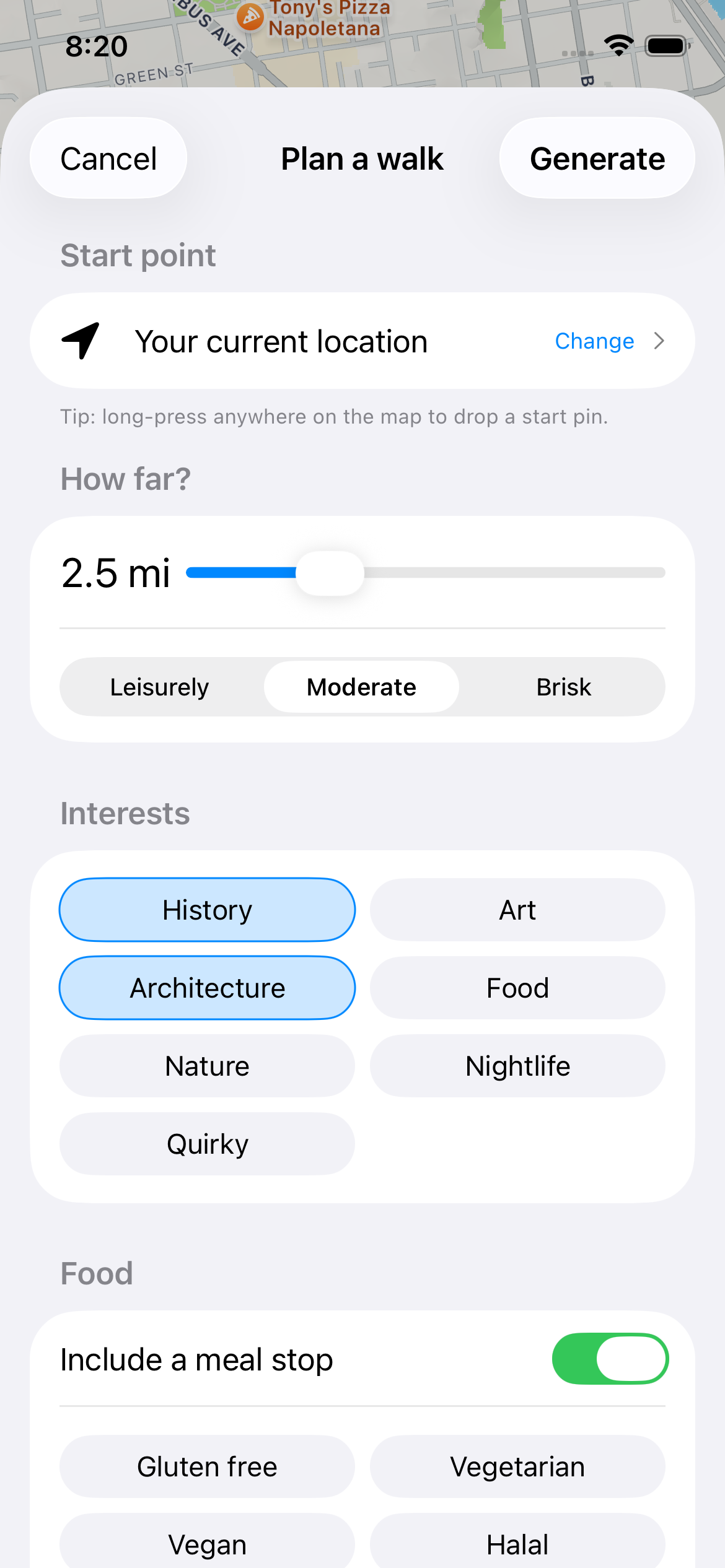
Mosey turns this route into an interactive experience — tap each stop for narration, maps, and local context. Build your own Williamsburg tour or customize this one at moseytourbuilder.com.
Download on the App Store — FreeMore Brooklyn & NYC Walking Tours with Mosey
If this Williamsburg walking tour leaves you wanting more Brooklyn, Mosey has routes worth exploring in Greenpoint — the Polish-American neighborhood directly north, where the food scene and quiet canal streets offer a noticeably different pace — and in Bushwick, southeast of Williamsburg, where the outdoor mural culture is even more concentrated and the gallery-to-block ratio rivals anywhere in the city. Manhattan's Lower East Side, directly across the Williamsburg Bridge, pairs naturally with this route as a half-day extension: the neighborhoods share deep historical ties, and the bridge walk between them takes about twenty minutes on foot.