Park Slope holds one of the largest collections of intact 19th-century rowhouses in the United States, and the neighborhood's entire history is legible from the sidewalk if you know where to look. This walk moves through the architectural core of the historic district, past churches and mansions built with Gilded Age money, and into the northern edge of Prospect Park, one of Frederick Law Olmsted and Calvert Vaux's two great Brooklyn works. It's a walk about brownstone, brick, and the money that built both — grain, oil, sugar, and the railroad fortunes that flowed into Brooklyn after the Civil War.
The route starts near Grand Army Plaza, works down through the Park Slope Historic District's best blocks, and finishes near Prospect Park's northern entrances with a stop for food. Along the way you'll pass rows of Romanesque Revival and Queen Anne houses, a landmarked church, and one of the most photographed library entrances in the city. None of it requires tickets or timed entry — this is a street-level, low-cost walk best done slowly.
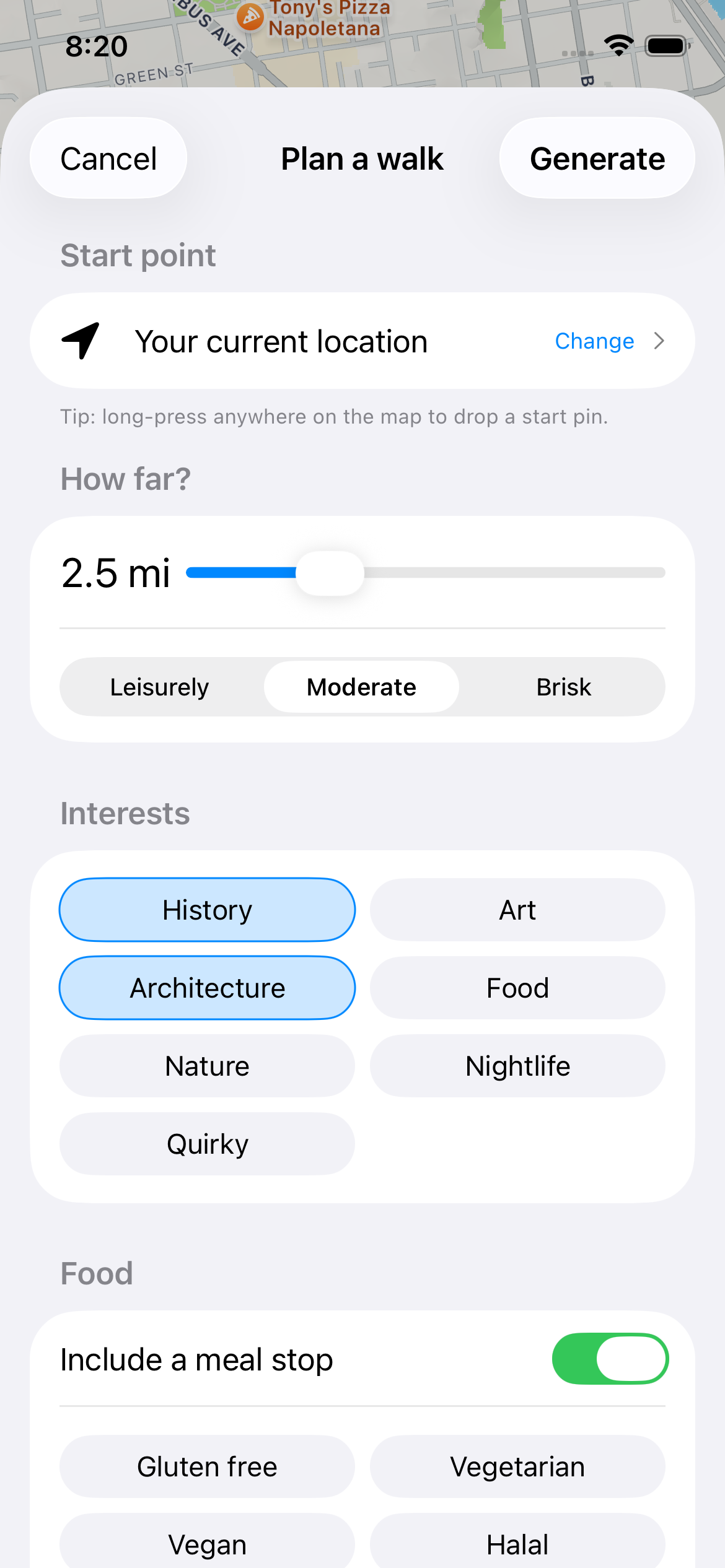
Mosey built this route to string together the stops that actually explain Park Slope's layout and architecture, rather than just listing pretty blocks. Open the app and it'll guide you turn by turn, surfacing the historical notes below right when you're standing in front of each building, so you're not toggling between a map and a guidebook.
The Route: 7 Stops Through Park Slope
"Designed by Olmsted and Vaux in the 1860s as a grand entrance to Prospect Park, the plaza's centerpiece is the Soldiers' and Sailors' Memorial Arch, completed in 1892 to honor Union Civil War veterans. The arch's bronze sculptural groups were added later, including work by Frederick MacMonnies depicting Columbia leading the Union Army. The plaza was modeled loosely on Parisian traffic circles, with the arch playing the role Napoleon's Arc de Triomphe plays at the Étoile."
Walk the full loop around the arch to see the bronze reliefs on all sides — the best light for photos is morning, when the sun hits the eastern face. The plaza itself is free and always open; the Prospect Park entrance just beyond it is where you'll return later in this walk.
"Built in 1891 at 25 Eighth Avenue, the Montauk Club was designed by Francis H. Kimball in a Venetian Gothic style modeled on the Ca' d'Oro palace in Venice. It was founded as a private social club for the neighborhood's newly wealthy residents, and its terra-cotta frieze depicts scenes from Montauk Native American history, an odd but deliberate design choice tying the building's name to its ornamentation. The club still functions today, one of the few 19th-century Brooklyn social clubs still in continuous use."
Stand across the street on Eighth Avenue to take in the full facade — the terra-cotta frieze band is easy to miss if you're standing too close. The building is private, but the exterior is the point of the stop and it's visible any time of day.
"Montgomery Place is often cited by architectural historians as one of the finest blocks of rowhouses in New York City. Nearly all the houses were designed by C.P.H. Gilbert in the 1880s, using a mix of Romanesque Revival and Queen Anne styles with rock-faced brownstone, turrets, and elaborate stoops. The block was developed during Park Slope's building boom following the completion of Prospect Park, when the neighborhood attracted merchants and professionals seeking proximity to the new park without Manhattan's density."
Walk the full block slowly — the variation in rooflines, bays, and stoop details rewards a slow pace more than almost any other block in the neighborhood. There's no traffic to speak of, so it's comfortable to stand in the street for photos during off-peak hours.
"Built in 1844 and located at 119 Pierrepont Street on the edge of the Slope's historic sightlines, this Gothic Revival church was designed by Minard Lafever and is one of the oldest religious buildings tied to the neighborhood's early development. Its brownstone construction predates most of the surrounding rowhouses by decades, making it a useful marker for how the area looked before the post-Civil War building boom transformed it into a residential district."
The exterior is the main draw on this walk; check ahead if you want to see the interior, as it's generally open only during services or by appointment. This stop works well as a brief pause and photo point before continuing toward Seventh Avenue.
"This is a 1930s reconstruction of a 1699 Dutch farmhouse that stood on the site and became the unlikely center of one of the bloodiest engagements of the Battle of Brooklyn in 1776, when Maryland troops held off British forces here to allow George Washington's army to retreat. The original house was demolished in the 19th century, and the site was later buried under landfill used to build the Washington Park ballfield, home to early Brooklyn Dodgers games before the team moved to Ebbets Field. It was rebuilt in 1930s using some of the original stones recovered from the site."
The small museum inside covers both the Revolutionary War battle and the site's baseball history, and admission is free, though hours are limited (typically weekend afternoons, so check before you go). It's a quiet, easy-to-miss stop tucked into JJ Byrne Playground at Fifth Avenue and 3rd Street, worth the short detour off the historic district's main blocks.
"The Long Meadow is the longest continuous meadow in any American city park, stretching roughly a mile through the western side of Prospect Park. Olmsted and Vaux considered Prospect Park, completed in 1867, superior to their earlier Central Park, in part because the site allowed for this kind of unbroken pastoral vista without cross streets interrupting the design. The meadow was engineered to look natural but is entirely constructed, with graded slopes and planted tree lines designed to create the illusion of a much larger, wilder landscape."
Enter near Grand Army Plaza and walk south along the meadow's edge rather than cutting straight across — the sightlines Olmsted designed are best appreciated from the path, not the open grass. Free and open daily; early evening in August brings out the most local activity, from pickup soccer to picnics.
"Park Slope's dining scene grew up alongside the brownstone revival of the 1960s and 70s, when young families and artists moved into the then-undervalued historic district and a wave of cafés and casual restaurants followed. Ample Hills Creamery, founded in Brooklyn in 2011, became one of the borough's best-known ice cream brands before expanding citywide, and its Prospect Park–adjacent locations are a neighborhood fixture on summer afternoons."
For a full meal, Ample Hills' nearby storefront works well as a lighter finish, or detour two blocks to Seventh Avenue for sit-down options like Stone Park Cafe. On a hot August day, this is the easiest, most crowd-tested way to end the walk — grab something and eat it on a bench facing the park.
Planning Your Walk
Best time to walk: August in Brooklyn runs hot and humid; start this walk in the morning before 11am or after 5pm to avoid peak heat, and expect little shade until you reach the park sections.
Shoes: Flat sidewalks and paved park paths throughout — comfortable walking shoes are fine, no hiking gear needed.
The narration: At each stop, Mosey surfaces short historical notes — architects, original owners, construction dates — pulled from landmarks records and neighborhood archives, so you get context without breaking stride.
Walk This Route with Mosey
Open the Mosey app to get turn-by-turn directions and stop-by-stop historical narration for this exact route, hands-free.
Download on the App Store — Free