DUMBO — Down Under the Manhattan Bridge Overpass — is one of New York City's most visually arresting neighborhoods, a compressed grid of Belgian-block streets and Romanesque Revival warehouses wedged between two of the world's most iconic bridges. What was once a gritty industrial district dominated by manufacturers like Arbuckle Brothers Coffee and Robert Gair's paper empire has transformed, over the past three decades, into a dense concentration of architecture worth stopping for, public art worth photographing, and history worth understanding. The bones of the 19th-century factory district are still very much present — in the iron loading-dock hardware, the water tower silhouettes, and the cobblestones that make sensible footwear non-negotiable.
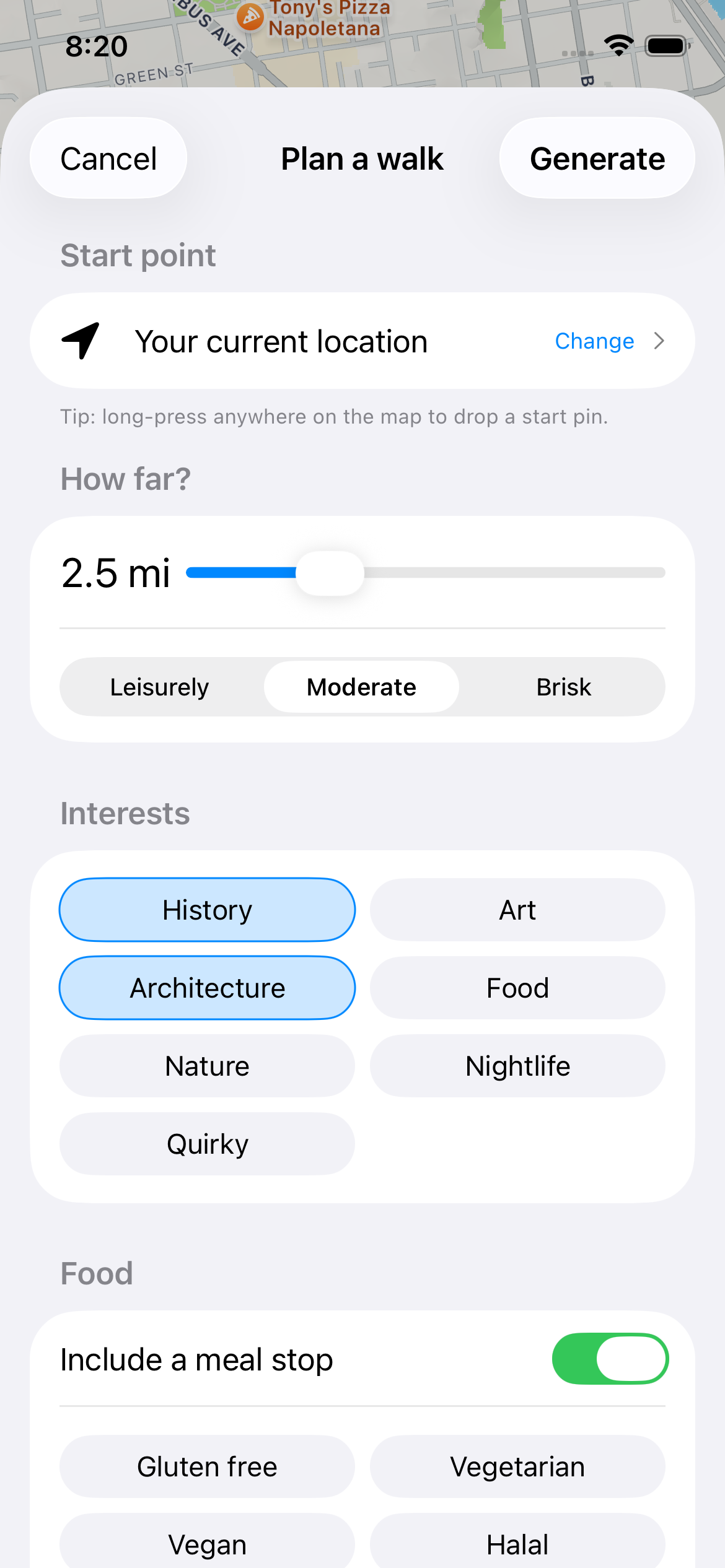
This self-guided tour, built with Mosey, threads through DUMBO's core from the Manhattan Bridge anchorage down to the waterfront at Brooklyn Bridge Park, hitting the neighborhood's most architecturally significant buildings, its celebrated street art corridor, and the carousel pavilion that has become shorthand for the neighborhood itself. Along the way, Mosey surfaces the layered history of each stop — who built it, who worked there, and how it evolved from warehouse to gallery to tech office to whatever it is today. You'll move through the neighborhood the way it rewards being moved through: slowly, on foot, looking up.
The route works best on a clear morning when the light hits the Manhattan Bridge steel and the cobblestones still glisten. July 4th weekends bring crowds to the waterfront for fireworks viewing, so plan to hit the Brooklyn Bridge Park stops early and save the interior gallery and arcade stops for midday when the waterfront is at its busiest. Wear shoes you trust on uneven stone and bring water — there's limited shade between the bridge anchorage and the park.
The Route: 7 Stops Through DUMBO's Architectural & Artistic Core
"The view from Washington Street looking north toward the Manhattan Bridge is one of the most photographed urban compositions in New York — a deliberate frame created by accident, the result of the bridge's 1909 construction cutting directly through an existing street grid. The buildings flanking the view are former factory warehouses built between the 1880s and 1910s, most associated with the empire of Robert Gair, a Scottish immigrant who invented the machine-made folding paper box in 1879 and built much of what you see here to house his printing and packaging operations. By the early 20th century, Gair employed thousands of workers in DUMBO and owned more than a dozen buildings in the neighborhood. The red-brick Romanesque Revival structures were designed to be functional but not unbeautiful — arched windows, corbeled cornices, and cast-iron details appear throughout."
Stand at the corner of Washington and Front and look north. The Manhattan Bridge's blue steel towers fill the gap between the brick walls perfectly — this is the shot, and the reason this corner is always busy. Come early to avoid crowds. The surrounding warehouses are now residential lofts and creative offices; you're not missing anything by not going inside. Just look up at the cornice work and the surviving painted ghost signs on the brick.
"The cluster of red-brick buildings along Water Street between Main and Adams Streets represents the heart of Robert Gair's manufacturing empire and collectively one of the most intact 19th-century industrial complexes surviving in New York City. Gair constructed his first DUMBO factory in 1885 following the success of his folding box invention; by the 1890s he controlled a vertically integrated operation that produced everything from cereal boxes to the packaging for Uneeda Biscuits. The buildings range from six to nine stories, with freight-elevator shafts, loading bays at street level, and the wide, column-free floor plates that heavy manufacturing required. After Gair's death in 1927 and the eventual departure of manufacturing from the neighborhood in the mid-20th century, these buildings sat underutilized for decades before artists began colonizing them in the 1970s and 1980s, laying the groundwork for DUMBO's creative-economy identity."
Walk slowly along Water Street and read the facades — you'll see different construction phases and brick colors indicating which buildings came first. Look for the original freight-loading ironwork at sidewalk level and the cast-iron pilasters on some facades. Most interiors are now residential or office space and closed to the public, but the exteriors and the scale of the complex are what matter here. The cobblestone street surface along this block is original.
"Pearl Street Triangle is a small public plaza that functions as the informal center of DUMBO's art identity — a node where murals, rotating public installations, and the neighborhood's street-art corridor converge. DUMBO began attracting artists in the late 1970s when Anchorage, the massive vaulted space inside the Manhattan Bridge anchorage, became an unconventional exhibition venue. By the 1990s, the neighborhood had enough working artists and galleries to support an annual arts festival, DUMBO Arts Festival, founded in 1997, which helped establish the district's national reputation. The surrounding blocks, particularly along Water Street and Pearl Street, have become a sanctioned outdoor gallery — building owners and the local BID (Business Improvement District) have commissioned large-scale murals that change periodically, making this stretch one of the more dynamic outdoor art corridors in the five boroughs."
Check the current murals along Pearl Street heading toward the waterfront — they rotate, so what's here in July 2026 will differ from earlier guides. The triangle itself is a good orientation point. If you want to see inside the Manhattan Bridge Anchorage, check anchoragearts.org for current programming; the space only opens for specific events and exhibitions, not as a general walk-in attraction. Don't skip the building facades on the south side of Water Street — some of the best painted works are up high.
"St. Ann's Warehouse occupies the Tobacco Inspection Warehouse, a striking 1860s brick building with a distinctive raw industrial interior that the theater company preserved and exposed when it renovated the space, which opened in its current form in 2015. The building was constructed as one of several Brooklyn warehouses used by the federal government for inspecting and bonding tobacco imports — a largely forgotten chapter in Brooklyn's 19th-century commerce. The theater company itself, founded in 1980 in a Manhattan church and relocated to DUMBO in 2001, has a reputation for commissioning and premiering adventurous international work; productions by the National Theatre of Scotland, Lou Reed, and Marianne Faithfull have all originated here. The renovation by Marvel Architects preserved the original brick walls, timber ceiling structure, and the irregular floor plan of the warehouse while creating a flexible 250-seat performance space."
Even if there's no performance during your visit, walk past and examine the exterior — the building sits at the corner of Jay and Water Streets with its original brick and loading-door hardware clearly visible. If the lobby is open, step in; the interior brick and exposed structure are worth a look. Check stannswarehouse.org for current programming before your visit — July often has summer productions scheduled.
"Brooklyn Bridge Park stretches 1.3 miles along the East River waterfront and was built on the former infrastructure of the Brooklyn piers — industrial shipping terminals that served the borough from the mid-19th century through the late 20th century. The park, designed by landscape architecture firm Michael Van Valkenburgh Associates and opened in phases beginning in 2010, is notable for how deliberately it preserved and incorporated the old pier structures, granite cobblestone mooring blocks, and industrial edge conditions into its design. Pebble Beach, the small gravel strand under the Manhattan Bridge anchorage, sits at the northern end of the park and offers one of the most direct views of both bridges simultaneously — the Manhattan Bridge's steel lattice directly overhead and the Brooklyn Bridge's Gothic Revival stone towers to the south. The piers themselves, now grassed-over recreation areas, rest on original timber piling foundations visible at low tide."
Pebble Beach is accessed through a gate just north of Main Street Lot — follow the park path down to the water. Arrive before 10am on July 4th weekend if you want a relatively uncrowded experience; by afternoon this waterfront will be extremely busy for fireworks staging. The view of both bridges from the water's edge is the architectural money shot of the entire tour. No entry fee; the park is open daily from 6am to 1am.
"Jane's Carousel is a 1922 Mangels-Illions carousel, originally built for Idora Park in Youngstown, Ohio, and purchased by artists Jane and David Walentas in 1984 at auction for $385,000 after the amusement park closed. The Walentases, who were the primary real-estate developers responsible for DUMBO's transformation (David Walentas began buying industrial buildings in the neighborhood in the 1970s), spent 27 years and several million dollars restoring the carousel's 48 horses and two chariots, hand-painted to their original 1922 specifications. In 2011, it was installed in a pavilion designed by Pritzker Prize-winning architect Jean Nouvel — a glass and steel enclosure that makes the restored carousel visible from the street and the bridge at all hours. The carousel was donated to the public and is operated as a nonprofit."
Rides cost $2 per person, cash or card, and the carousel runs Wednesday through Sunday (hours vary seasonally — check janescarousel.com before your visit). Even if you skip the ride, Nouvel's pavilion design is worth examining closely — the glass enclosure is engineered to disappear visually, keeping the 1922 carousel as the focal object. Look at the painted horses up close; the restoration detail is extraordinary. On July 4th, confirm hours in advance as the park schedule changes for holiday events.
"Juliana's occupies a storefront in one of DUMBO's oldest surviving commercial blocks on Old Fulton Street, a cobblestone stretch near the base of the Brooklyn Bridge that predates the bridge itself — the street was a primary route to the Fulton Ferry landing, which connected Brooklyn and Manhattan from 1814 until the bridge opened in 1883. The pizza at Juliana's was created by Patsy Grimaldi, the legendary pizzaiolo who originally ran the celebrated Grimaldi's (now located under the bridge) before a lease dispute led him to open this spot in 2012. The restaurant uses a coal-fired oven and a thin-crust Neapolitan style that made Grimaldi's famous — many pizza obsessives consider Juliana's the superior version. Old Fulton Street itself is one of the few blocks in DUMBO where the 19th-century commercial scale is still legible at street level."
Juliana's does not take reservations and is cash and card accepted. Expect a wait on weekends and holiday weekends — lines form before the noon opening. Arrive right at opening (check current hours at julianaspizza.com) or plan for a late lunch after 2pm when the initial rush subsides. Order the plain or the white pie; both are exceptional. The outdoor tables on Old Fulton Street give you a direct view of the Brooklyn Bridge towers above the roofline — worth waiting for a table rather than taking whatever's first available inside.
Planning Your DUMBO Self-Guided Walk: Practical Tips
Best time to walk: July in Brooklyn is hot and humid, often reaching the high 80s°F. The waterfront at Brooklyn Bridge Park catches a river breeze, but the interior cobblestone blocks between the bridges radiate heat. Start by 9am if possible. Bring sunscreen — the park is fully exposed. Rain turns the Belgian-block streets slick; flat rubber soles are safer than anything with a heel.
Shoes: The Belgian-block (cobblestone) streets throughout DUMBO are charming and genuinely uneven. Wear closed-toe shoes with flat, grippy soles. Sneakers are ideal. Avoid sandals, heels, or anything with a narrow sole.
The narration: At each stop, Mosey surfaces the architectural period, original industrial use, and the specific transformation that brought each building or space into its current life.
Walk DUMBO With Mosey
Mosey built this route — load it on your phone and get turn-by-turn navigation, historical narration at every stop, and offline access so you're not hunting for signal on the waterfront. Free to use, no account required.
Download on the App Store — FreeExplore More Brooklyn & Manhattan Neighborhoods with Mosey
If DUMBO's industrial-to-creative arc has you wanting more, the neighboring waterfront neighborhoods reward further exploration with Mosey. Brooklyn Heights, directly up the hill via the Squibb Park Bridge or the pedestrian path from Brooklyn Bridge Park, offers a completely different architectural register — Federal and Greek Revival rowhouses from the 1820s through 1860s on some of the most intact 19th-century residential streets in the United States. Vinegar Hill, tucked behind the Con Edison substation just north of DUMBO, is a tiny, almost eerily quiet enclave of pre-Civil War frame houses and cobblestone lanes that most visitors entirely miss. And across the river, if you're willing to extend the day, Lower Manhattan's Seaport District tells the complementary story from the Manhattan side of the same industrial waterfront economy that made DUMBO's warehouses necessary in the first place.