Back Bay is the best place in Boston to read a city plan on the ground. Until the 1850s this was a tidal basin west of the Public Garden. Starting in 1857, trainloads of gravel from Needham filled it, and the new streets were laid out in a strict grid: Arlington, Berkeley, Clarendon, Dartmouth, running alphabetically west, crossed by Beacon, Marlborough, Commonwealth, Newbury and Boylston. That order makes it an easy self-guided Back Bay tour. If you know the alphabet, you know where you are.
This route is built for architecture and history. It starts in Copley Square with three buildings that argue with each other across one plaza: a Renaissance Revival library, a Romanesque church by H. H. Richardson, and a Gothic-style church with a tall tower. It then follows the Commonwealth Avenue Mall east, stops inside a preserved 1860 townhouse on Beacon Street, and ends at the church that was the first public building in the neighborhood, followed by lunch on Boylston Street.
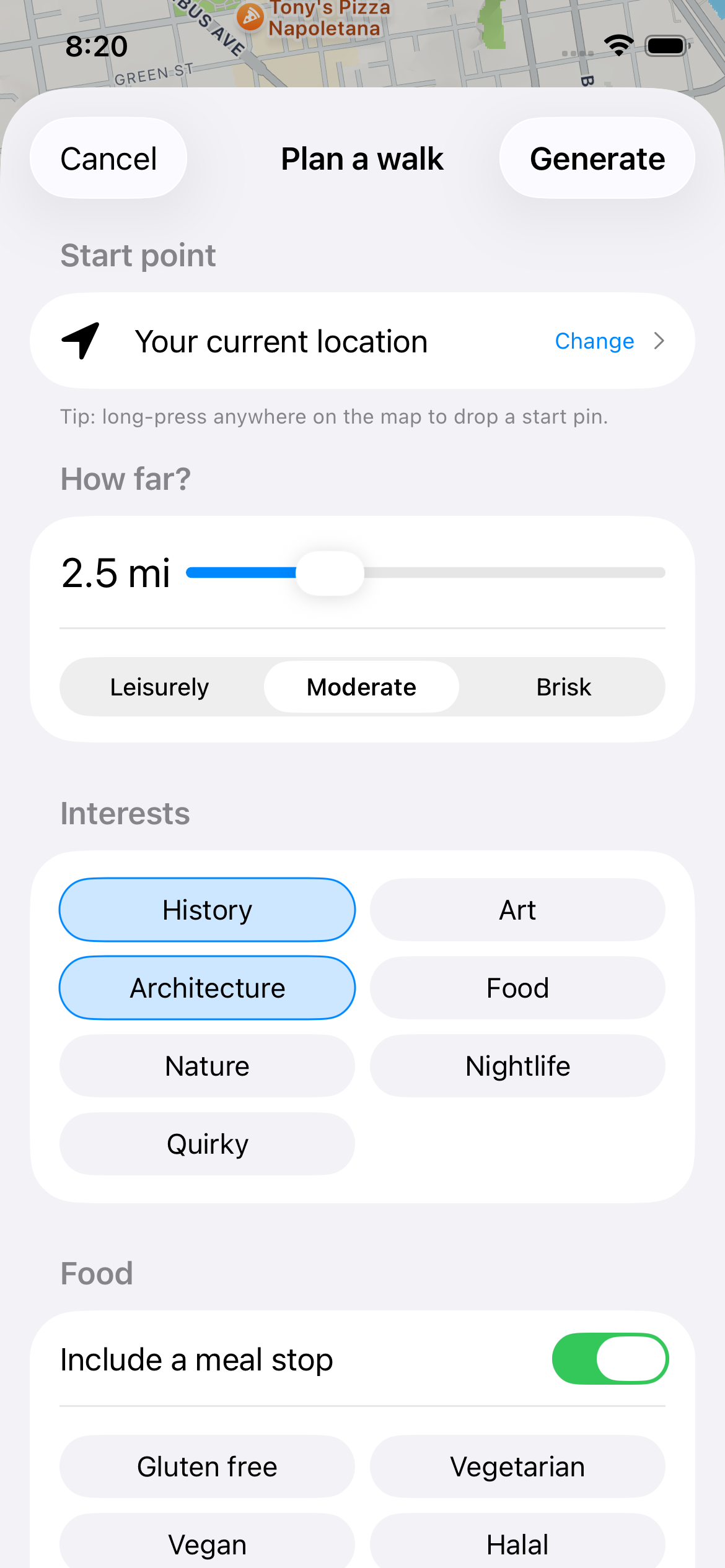
The Mosey app built this route and delivers the context for each stop as you reach it, so you can keep your eyes on the cornices instead of a phone screen. Budget about two and a half hours at an easy pace. Add time if you take the Gibson House tour or linger in the library. Late October is a good time to go, with the Mall's trees turning and the light low on the brownstones in the afternoon.
The Route: From Copley Square to the Public Garden Edge
"The Boston Public Library was founded in 1848 and is generally described as the first large free municipal library in the United States. The Copley Square building opened in 1895 and was designed by Charles Follen McKim of McKim, Mead & White, who modeled the facade on Italian Renaissance palazzi. Inside, the grand staircase is lined with murals by Pierre Puvis de Chavannes, and Bates Hall, the main reading room, has a barrel-vaulted ceiling. The bronze entrance doors are by sculptor Daniel Chester French."
Entry is free. Walk through the entrance hall and up the marble staircase, then continue into the arcaded courtyard at the center of the building, which is a quiet place to sit even on a busy day. Bates Hall is a working reading room, so keep your voice down and skip flash photography. Free guided tours run on a set schedule that changes by season, so check the library's site before you go.
"Trinity Church, at 206 Clarendon Street, was designed by Henry Hobson Richardson and consecrated in 1877. It established the Romanesque style that came to be called Richardsonian Romanesque. Because the site was filled tidal land, the building rests on thousands of wooden piles driven into the fill, and the groundwater level around it still has to be monitored to keep those piles wet. The interior murals and decorative scheme were directed by John La Farge. Across the street, the John Hancock Tower (1976, designed by Henry N. Cobb of I. M. Pei & Partners) mirrors the church in its glass walls."
Stand on the Copley Square plaza side, near the fountain, and look at the church and the tower reflection together; that view is free and arguably better than going in. The interior charges admission for visitors, and it is closed to tourists during services, so check hours for the day. Do pay if the interior matters to you: the La Farge color is the main event.
"Old South Church, at 645 Boylston Street, was designed by Cummings and Sears in a Northern Italian Gothic style, with a tall tower and bands of contrasting stone. The congregation itself dates to 1669 and moved to Back Bay from its earlier meetinghouse downtown, which still stands as the Old South Meeting House on Washington Street. The Back Bay building was completed in the mid-1870s, which makes it a neighbor and near-contemporary of Trinity."
The best spot is the corner of Dartmouth and Boylston, where you can see the tower and the polychrome stonework against Trinity's heavier mass. Do not confuse this with the Old South Meeting House downtown, which is a separate building and a separate museum. The sanctuary is open at limited times, so treat this as an exterior stop unless the doors happen to be open.
"Commonwealth Avenue was laid out by architect Arthur Gilman as the grand axis of the new Back Bay, with a central tree-lined mall that echoes the Parisian boulevards of the Haussmann era. Filling of the bay began in 1857 and the neighborhood's blocks were built out over the following decades. Along the mall you pass sculptures including the granite statue of Alexander Hamilton by William Rimmer (1865) and the Leif Erikson statue by Anne Whitney (1887). The rowhouses on both sides show the shift from the earlier French Academic styles to Queen Anne and Romanesque Revival."
Enter the mall at Dartmouth Street and walk east toward the Public Garden, reading the statue plaques as you go. Look up at the rooflines: mansard roofs mark the earlier French-influenced houses, and the rounded bays and heavy stonework mark the later ones. Most of the grand houses are now condos, offices or university buildings, so this is an exterior stop. If you want shops on the way, Newbury Street runs parallel one block south and has the stores, though the architecture is better on Commonwealth.
"The Gibson House, at 137 Beacon Street, was built in 1860 to a design by Edward Clarke Cabot for Catherine Hammond Gibson. It stayed in the Gibson family for three generations, and the last occupant, Charles Gibson Jr., lived there until his death in 1954. The house opened as a museum in 1957 with its furnishings and household arrangements largely intact, which makes it one of the few places where you can see how a Back Bay family actually lived, including the service spaces where servants worked."
Entry is by guided tour only, and there is an admission fee. Tours run on a limited weekly schedule, so check dates and book ahead before planning your route around it. If tour times do not fit, the exterior still gives you a good look at an early Back Bay brownstone front. Skip it if you are short on time, because it adds close to an hour.
"Arlington Street Church, at 351 Boylston Street across from the Public Garden, was designed by Arthur Gilman and Gridley J. F. Bryant and completed around 1861. It was the first public building constructed in Back Bay. The steeple is modeled on London's St Martin-in-the-Fields, and the church is known for its Tiffany stained-glass windows. The congregation is Unitarian Universalist and has a long record of taking public positions on social issues."
Stand across Arlington Street near the Public Garden gate to take in the whole front and steeple. The sanctuary is open at limited hours, so call or check the church's schedule if you want to see the windows. This is also the point to look back along Boylston Street and see how quickly the neighborhood's scale changes from here toward Copley.
"Parish Cafe, at 361 Boylston Street, sits directly beside Arlington Street Church on one of Back Bay's oldest commercial strips. Boylston Street's low rowhouse-scale buildings here were converted to shops and restaurants over time, and the cafe operates in one of those ground-floor spaces. It is known locally for a menu of sandwiches attributed to Boston-area chefs, and for its bar."
Go for a late lunch to avoid the noon rush and the weekend line. Expect a casual, sit-down meal with a sandwich-forward menu, and check current hours before you commit, since restaurant schedules change. If it is packed, there are plenty of alternatives within a short walk along Boylston and on Newbury Street.
Before You Go: Tickets, Timing and What to Skip
Best time to walk: Late October in Boston is typically cool, roughly 45 to 60 degrees, with sudden wind between the tall buildings along Boylston Street. Bring a layer you can take off indoors. Rain is common in fall and the route has plenty of indoor stops to wait it out. Leaves on the Commonwealth Avenue Mall are usually at their best in late October to early November. Winter is colder than most visitors expect, and summer afternoons can be humid.
Shoes: Flat, comfortable shoes are enough. The route is all paved sidewalk and gravel paths on the Mall, with no real hills. Brick sidewalks in Back Bay are uneven, with raised edges where tree roots have pushed them up, so skip heels and watch your step if you are looking up at facades.
The narration: At each stop Mosey surfaces the architect, the date, the building materials and the documented events behind what you are looking at, so the facade in front of you comes with its backstory.
Build Your Own Back Bay Walk
Open Mosey, pick your pace and interests, and get this Back Bay route with historical context at every stop. Adjust the stops to fit your time.
Download on the App Store — FreeFrequently asked questions
How long does it take to walk Back Bay?
A focused Back Bay walk covering Copley Square, Commonwealth Avenue and Beacon Street takes about 2.5 hours at an easy pace. The route is roughly 2 miles on flat sidewalks. Add 45 minutes if you take the Gibson House tour, and extra time for a long lunch.
Is Back Bay walkable?
Yes, Back Bay is one of Boston's easiest neighborhoods to walk. It sits on filled land with no real hills, and its grid runs alphabetically from Arlington to Hereford Street. The main sights cluster around Copley Square and Commonwealth Avenue, and the MBTA Green Line runs along its edge.
What is the best route through Back Bay for architecture?
Start at the Boston Public Library in Copley Square, see Trinity Church and Old South Church, then walk east along the Commonwealth Avenue Mall to Arlington Street. That sequence moves from 1870s landmarks to rowhouses and finishes at Arlington Street Church, the neighborhood's first public building.
Is Trinity Church free to enter?
No, Trinity Church charges visitors an admission fee for interior access, and the sanctuary closes to tourists during services. The exterior and Copley Square view are free. Check the church's current hours before going, because they vary by day and season.
What is the best time to walk Back Bay?
Late morning to mid-afternoon on a weekday is best, when the library and churches are open and sidewalks are less crowded. Fall is a good season, with tree color on the Commonwealth Avenue Mall in late October. Avoid Marathon Monday in April unless you want the crowds.
More Boston Walks After Back Bay
If Back Bay leaves you wanting more, Beacon Hill is the obvious next walk, with gas lamps, brick rowhouses and Acorn Street just across the Public Garden. The South End has the largest intact Victorian rowhouse district in the country, and the Freedom Trail picks up Boston's colonial and Revolutionary history downtown. Mosey can build any of these as a self-guided route with the same stop-by-stop context.