Four square blocks of downtown Birmingham hold more twentieth-century American history than almost anywhere else in the country. This is where police commissioner Bull Connor turned fire hoses and dogs on schoolchildren in May 1963, where four girls died in a Sunday morning bombing, and where the images that ran on national television changed the course of the civil rights movement. The district is compact and walkable, and it's designed to be walked slowly — this isn't a place to rush through between coffee stops.
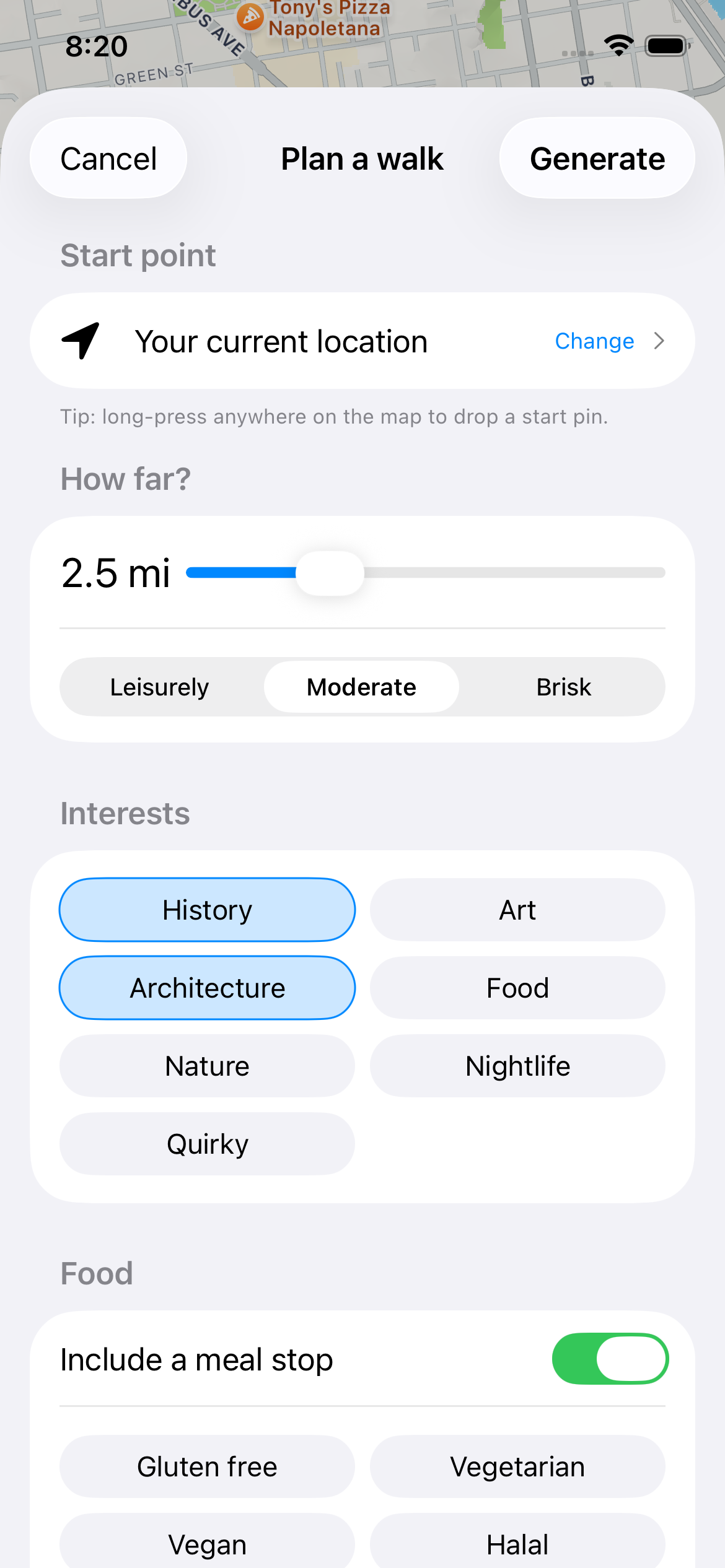
The route below starts at Kelly Ingram Park, loops past the Civil Rights Institute and 16th Street Baptist Church, and works south through downtown's older commercial blocks before ending with a meal at a Birmingham institution. Along the way you'll pass Art Deco office towers, a WPA-era federal building, and public sculpture that doesn't soften what happened here. Mosey lays out the route on your phone and surfaces the historical context at each stop as you arrive, so you're not standing on a corner reading a plaque while traffic goes by.
Budget a slow morning or early afternoon for this. Late September in Birmingham still runs warm, and several stops — the Institute, the church — are worth entering rather than viewing from the sidewalk, which adds time. Nothing here is rushed history. Treat it that way.
The Route: Seven Stops Through Downtown Birmingham
"Originally platted in 1932 and named for Osmond Kelly Ingram, the first U.S. Navy sailor killed in World War I, this four-acre park became the staging ground for the Birmingham Children's Crusade in May 1963. On May 3, Commissioner Eugene 'Bull' Connor ordered fire hoses turned on demonstrators and police dogs released into the crowd, images photographed by Bill Hudson that ran on front pages nationwide. The park was redesigned in 1992 with sculptures by artist James Drake and others, including bronze figures depicting the police dogs and a kneeling minister, arranged along a walking path called 'Freedom Walk.'"
Walk the full loop rather than cutting across — the sculptures are arranged to be encountered in sequence, and skipping ahead undercuts the design. Morning light is best for photos of the dog sculptures near the 16th Street side. It's free and open all hours, but visit during daylight.
"Built in 1911 by Black architect Wallace Rayfield, this was the largest Black church in Birmingham and a regular meeting point for civil rights organizing. On September 15, 1963, a bomb planted by Ku Klux Klan members exploded under the church's east steps during Sunday morning services, killing four girls — Addie Mae Collins, Cynthia Wesley, Carole Robertson, and Denise McNair, all 11 to 14 years old. The last of the men responsible, Bobby Frank Cherry, wasn't convicted until 2002, nearly 39 years after the bombing."
The church offers guided tours Tuesday through Saturday for a small donation (around $5); check current hours before you go since the schedule shifts around service times. Sunday morning is for worship, not tourism — plan your visit for a weekday. Stand across 6th Avenue near the park to see the building's full facade before crossing.
"Opened in November 1992 directly across from Kelly Ingram Park, the Institute was built specifically to sit within sightline of the church and park where the events it documents took place. Permanent exhibits move chronologically through Jim Crow-era Birmingham, the 1963 campaign, and the broader movement, using oral histories, original artifacts, and a re-created segregated classroom and jail cell. The museum sits inside the same National Historic Landmark District as the church and park, one of relatively few sites in the country where a museum, a memorial park, and the actual historic building sit within a block of each other."
General admission runs around $15 for adults with discounts for students and seniors; budget at least an hour, more if you read exhibit text closely. It gets busy with school groups on weekday mornings during the academic year, so an early afternoon visit on a weekday is calmer. Photography is restricted in some exhibit areas — signage tells you where.
"This stretch of 4th Avenue North was Birmingham's Black business district under segregation, home to Black-owned banks, insurance companies, theaters, and the offices of Black-owned newspapers like the Birmingham World. The Colored Masonic Temple at 1630 4th Avenue North, completed in 1922, housed A.G. Gaston's early business ventures before Gaston built his own headquarters nearby; Gaston went on to become one of the wealthiest Black businessmen in the South and quietly funded bail for jailed civil rights demonstrators in 1963."
Walk the block slowly and look up — most of the historic detail is on upper-story facades, not storefront level. Some buildings are still in active restoration, so exteriors are more reliable than interiors here. This is a good stretch to slow your pace after the emotional weight of the Institute and church.
"Opened in 1927 as a movie palace for Paramount Pictures, the Alabama Theatre was designed with an ornate Spanish-Moorish interior and originally seated over 2,500 people. It's one of the last surviving atmospheric theaters in the South, complete with a Mighty Wurlitzer organ still played before film screenings. The building faced demolition threats in the 1980s before a nonprofit formed to preserve it, and it now runs a regular calendar of classic film screenings and live shows."
Unless there's a matinee or event, you'll mostly be viewing the marquee and lobby from the street — check their event calendar in advance if you want to see the interior. The block outside is a good five-minute stop rather than a destination in itself. Worth the short detour off the main civil rights route for the contrast in eras.
"Birmingham's City Hall, completed in 1950, sits at the edge of Linn Park, formerly known as Woodrow Wilson Park until it was renamed in 1988 for pioneering city planner Charles Linn. This civic core is where much of the political decision-making around the 1963 protests happened, including Bull Connor's own office, which operated out of City Hall until he lost a 1963 runoff election to Albert Boutwell amid the fallout from the Children's Crusade coverage."
There's not much to go inside for unless you have city business, but the plaza and park are worth a five-minute pause, especially if you want shade on a hot afternoon. It's a useful midpoint to reorient before heading toward the meal stop.
"A short rideshare or ten-minute drive from downtown (walking the full distance adds real time to your day), Niki's West has served cafeteria-style Southern food since 1957 and moved to its current Finley Avenue location in the 1970s. It's known for a rotating steam-table lineup of vegetables, fried chicken, and cornbread, and it's long been a lunch spot for Birmingham judges, city workers, and civil rights-era figures alike. Locals order by pointing, not by menu."
It's cafeteria-style: grab a tray, point at what you want, pay at the register — cash and card both work, average ticket runs $10–15. Lunch rush hits hard between 11:30am and 1pm on weekdays; arrive right at 11am to beat the line. If a longer walk back downtown doesn't appeal, factor a short drive or rideshare into your day rather than treating this as a walking leg.
Planning Your Visit
Best time to walk: September in Birmingham still runs 80s°F with real humidity. Mornings before 10am are noticeably more comfortable. Afternoon thunderstorms are common this time of year, so check the radar before you start.
Shoes: Flat sidewalks and paved park paths throughout — comfortable walking shoes are fine, nothing technical.
The narration: Mosey pulls in primary details — court records, newspaper accounts from 1963, architects' names, National Register documentation — so the context at each stop is specific rather than summarized.
Build This Walk in the Mosey App
Get turn-by-turn navigation and stop-by-stop historical narration for this route on your phone, free to start.
Download on the App Store — FreeFrequently asked questions
How long does it take to walk Birmingham's Civil Rights District?
Plan on 2.5 to 3 hours for the full route covering roughly 2 miles, including time inside the Civil Rights Institute and 16th Street Baptist Church. Walking alone without stopping takes under an hour, but the sites here reward slower visits, especially the museum, which alone can take 60–90 minutes.
Is the Birmingham Civil Rights District safe to walk?
Yes, during daytime hours the district around Kelly Ingram Park, the church, and the Institute sees steady foot traffic from visitors and is well-patrolled. Like most downtown areas, it's quieter and less populated after dark, so plan your walking route for daylight hours, roughly 9am to 5pm.
Do you need tickets in advance for the Birmingham Civil Rights Institute?
Advance tickets aren't required for general admission, but buying online ahead of a visit avoids the ticket-counter line, especially on weekday mornings when school groups arrive. Admission runs around $15 for adults, with discounted rates for students, seniors, and children. The museum is closed on Mondays.
Can you visit 16th Street Baptist Church without a tour guide?
No — visitors need to join a guided tour to see the interior, offered Tuesday through Saturday for a small donation, typically around $5 per person. The church still holds active Sunday services, so it's not open for casual visits that day. Check the church's posted schedule since tour times shift seasonally.
What's the best time of day to walk this route in Birmingham?
Weekday mornings between 9am and noon work best — the Institute is less crowded, temperatures are more manageable especially in warmer months, and the church tour schedule aligns with morning and early afternoon slots. Avoid Sunday mornings, when the church is in active worship rather than open for touring.
Is Kelly Ingram Park free to visit?
Yes, Kelly Ingram Park is a public city park with no admission fee and no set hours for walking the paths and viewing the sculptures. It sits directly across the street from both the Civil Rights Institute and 16th Street Baptist Church, making it a natural starting or ending point for the walk.
More Birmingham Walks to Build with Mosey
Birmingham rewards walking beyond the Civil Rights District, too. The Lakeview and Five Points South neighborhoods pair well with an evening food-and-nightlife route, while the industrial history around Sloss Furnaces on the city's east side makes for a shorter, single-site Mosey walk focused on the region's iron and steel past. If you're building a multi-day Birmingham itinerary, Mosey can map out either as a standalone route alongside this one.