Mount Vernon is where Baltimore put its money in the nineteenth century, and the evidence is concentrated along a few blocks of North Charles Street. A Robert Mills column anchors four small park squares. A Latrobe cathedral sits to the south, and a conservatory, a library and an art museum fill the blocks in between. For a Baltimore Mount Vernon walking tour, the district is compact and easy to follow, and the architecture runs from Federal-era classicism to Gothic Revival to Beaux-Arts.
This self-guided Mount Vernon tour starts at the Basilica of the National Shrine of the Assumption, moves north along Charles Street to the Gothic spire of Mount Vernon Place United Methodist Church, then drops into the Peabody Library and circles the Washington Monument. It continues to the Walters Art Museum and ends with dinner at Helmand, a long-running Afghan restaurant on North Charles. Six stops, one meal, mostly flat sidewalks.
The Mosey app built this route so the history arrives where you are standing: who commissioned each building, what it was made of, and what changed after. Your first three tours on Mosey are free. Check opening days before you go, because several of the interiors on this route keep short or irregular hours.
The route: from Latrobe's dome to the Washington Monument and dinner on Charles Street
"Benjamin Henry Latrobe designed the Basilica, and its cornerstone was laid in 1806. It was dedicated in 1821 and is regarded as the first Catholic cathedral built in the United States. Latrobe, who also worked on the U.S. Capitol, gave it a neoclassical form with a low dome and a skylit interior instead of a Gothic silhouette. A major restoration was completed in 2006 and returned the interior closer to Latrobe's intended light and colors."
Walk in through the main doors on Cathedral Street and stand under the dome to see how the skylights illuminate the nave. Entry is free, though visiting hours around services vary, so look at the posted schedule. Docent tours are offered at set times. Skip the gift shop unless you want a keepsake.
"Thomas Dixon designed this church at 10 East Mount Vernon Place, and it was completed in 1872. It is a Gothic Revival building whose tall spire anchors the eastern end of the square. It was built when the neighborhood was becoming the city's most fashionable address, and it faces the Washington Monument across the park."
This is mainly an exterior stop. Cross to the park side of the square to see the spire and the front facade together. The interior is generally open only during services and scheduled events, so do not plan your day around going in.
"The Peabody Institute was founded by the financier and philanthropist George Peabody, and its first building at 1 East Mount Vernon Place opened in 1866, designed by Edmund G. Lind. The library hall, completed in 1878, is the part people photograph: a skylit atrium surrounded by five tiers of cast-iron balconies, filled with books in gold-stamped bindings. The building now belongs to Johns Hopkins University."
Stand just inside the entrance and look straight up at the tiers; that is the best angle. Access is limited to set visiting hours, and private events can close it entirely, so confirm before you arrive. Entry is typically free for casual visitors. Do not touch the shelves.
"Robert Mills designed Baltimore's Washington Monument, and its cornerstone was laid on July 4, 1815; it was completed in 1829. The Doric column rises about 178 feet and is topped with a statue of George Washington by Enrico Causici. Mills later designed the better-known Washington Monument in Washington, D.C. Land for the surrounding squares came from the estate of Revolutionary War officer John Eager Howard."
Walk the full circle of the park and note how the four arms of the squares radiate from the column. The base has a small museum, and you can climb the interior steps to the top for a view over the rooftops; there is a modest fee and the climb is narrow. Skip the climb if you have knee trouble or are walking in strong wind. The bronzes by Antoine-Louis Barye in the park are worth a pause.
"The Walters at 600 North Charles Street grew out of the collection of Henry Walters, who left his holdings and gallery to the city of Baltimore when he died in 1931. The museum opened to the public in 1934. The original gallery building, designed by Delano & Aldrich and finished in 1904, takes its cue from an Italian Renaissance palazzo. Admission has been free since 2006."
The museum is generally closed on Mondays and Tuesdays, and November 23, 2026 falls on a Monday, so move this stop to another day or enjoy the exterior only. When it is open, head first to the Renaissance and Baroque rooms in the original palazzo. Allow 30 to 45 minutes unless you want the deeper collections, which can run far longer.
"Helmand, at 806 North Charles Street, opened in 1989 and is among the best-known Afghan restaurants in the mid-Atlantic. It was founded by Qayum Karzai, who is the brother of former Afghan president Hamid Karzai. The restaurant's long run on North Charles reflects Mount Vernon's shift from private mansions to a mix of arts institutions, restaurants and apartments."
Order the kaddo borani, a sweet-savory pumpkin dish with yogurt, and ask which lamb dishes are on that evening. Dinner is the main service, so check opening hours, and reserve ahead on weekends. It is a short walk back toward the monument if you want a nighttime look at the lit column.
Before you go: opening days, the Monday problem and when to start
Best time to walk: Late fall and early spring are the best windows: cool enough for a brisk walk, with bare trees that open up the building facades around the squares. Baltimore summers are humid and the squares offer little shade at midday. In late November expect temperatures that call for a coat, and daylight fades by about 5 p.m., so start the walk by early afternoon if you want to see the monument in daylight. Early December brings the annual lighting of the Washington Monument and a crowd with it.
Shoes: Mostly flat brick and concrete sidewalks, with uneven brick pavers and occasional steep marble steps at building entrances. Comfortable walking shoes are fine. If you plan to climb the Washington Monument, that is a spiral stair with a lot of steps, so expect tired calves.
The narration: At each stop Mosey surfaces the architect, the year, the building material and the person who paid for it, so you know what you are looking at before you read a plaque.

Walk Baltimore's Mount Vernon with Mosey
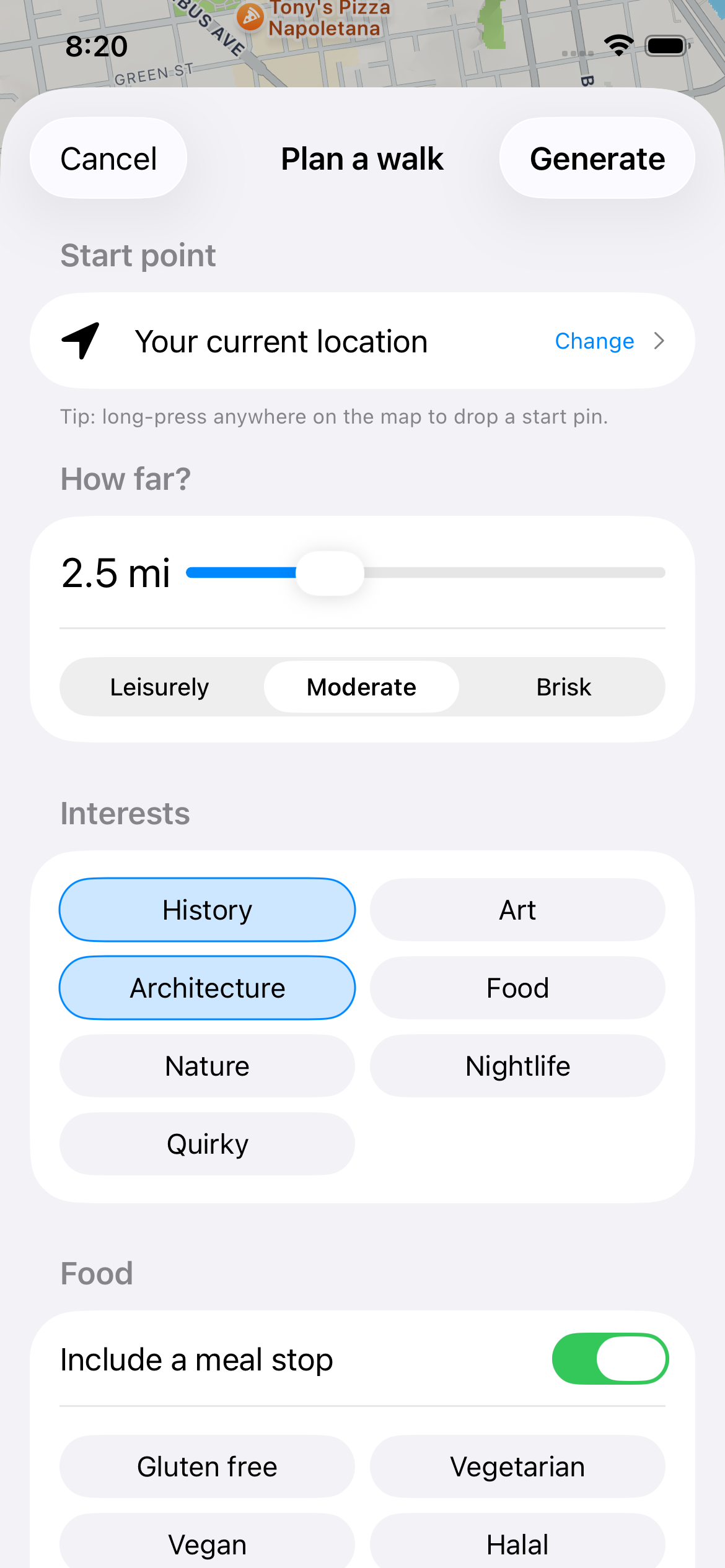
Mosey plans a walk like this one on your iPhone, starting wherever you choose.
- Set a distance or a time and pick what you're into
- Real stops in a walking order that makes sense on foot
- The story behind each stop, read aloud as you arrive
- A meal stop that fits the route

Free to download. iPhone, iOS 17 or later.
Frequently asked questions
How long does it take to walk Mount Vernon in Baltimore?
Plan about two and a half hours for this route, which covers 1.8 miles across six stops. Walking alone takes under an hour; the rest goes to the Basilica interior, the Peabody Library atrium, the Washington Monument and a sit-down meal. Adding the Walters collection can stretch it to four hours.
Is Mount Vernon in Baltimore walkable?
Yes, Mount Vernon is one of Baltimore's most walkable neighborhoods. The main sights cluster along North Charles Street and the squares around the Washington Monument. Sidewalks are flat and brick-paved, and the Light Rail, Metro and Charm City Circulator serve the edges, so you can arrive without a car.
Is the Washington Monument in Baltimore free to visit?
The park and exterior are free any time. Climbing the interior spiral stair to the top and visiting the small museum in the base usually charges a modest admission fee, and opening days are limited. Check the current hours and fee before you go, since both can change by season.
Is the Walters Art Museum free?
Yes, general admission to the Walters Art Museum at 600 North Charles Street has been free since 2006. Special exhibitions may carry a charge. It is typically open Wednesday through Sunday and closed Monday and Tuesday, so confirm current hours before planning a Monday walk.
Is Mount Vernon Baltimore safe to walk at night?
Mount Vernon is generally busy in the evening because of its restaurants, theaters and the Peabody Institute, but conditions vary block by block. Stay on North Charles Street and the lit squares, keep valuables out of sight, and use a rideshare for the trip back if you are heading beyond the neighborhood.
What is the best time of year for a Mount Vernon walking tour?
Spring and fall are best, with mild temperatures and open views of the facades. Early December adds the annual lighting of the Washington Monument, but also crowds. Summer midday is hot and the squares have limited shade, so go early morning or near dusk.
More Baltimore walks to build with Mosey
Once you have covered Mount Vernon, Mosey can build routes through neighboring Baltimore areas with a different character. Fells Point is the old maritime waterfront with cobblestone streets and taverns, while Federal Hill looks over the Inner Harbor from rowhouse streets and the Cross Street Market. Station North, a short walk north of Mount Vernon, has the Charles Theatre and a concentration of murals and arts spaces.