Sixth Street is Austin's most famous block — and also its most misunderstood. Yes, it's the honky-tonk strip that draws weekend crowds and bachelor parties, but the stretch between Congress Avenue and Interstate 35 is also one of the best-preserved collections of Victorian commercial architecture in the American South. These 1870s and 1880s limestone and brick storefronts were built by German and Swedish immigrants who turned a muddy cattle-drive town into a regional capital almost overnight, and the bones of that ambition are still visible above every neon beer sign.
This self-guided tour moves west to east along Sixth Street, starting at the old heart of political Austin near Congress Avenue and pushing toward the live-music corridor before ending at a classic Austin barbecue institution. Along the way, Mosey surfaces the layered history at each stop — the saloons that doubled as political headquarters, the buildings that survived fire and flood and urban renewal, and the specific musicians whose careers launched from these stages. The route is flat and walkable, but the stories at each stop reward you for slowing down.
Plan to start mid-morning on a weekday if you want to move freely through the historic blocks without the weekend foot traffic. By the time you reach the music venues on the eastern end, the early evening sets will just be starting — which is exactly the point. Wear comfortable shoes, download the Mosey app before you leave, and keep this guide open at each stop for the context that turns a bar crawl into a genuine history walk.
The Route: 7 Stops Through Austin's Historic Music Corridor
"The Scarbrough Building at 408 Congress Avenue — just steps from where Sixth Street meets Congress — was completed in 1910 and was Austin's first 'skyscraper,' rising eight stories in a city that had never built higher than four. It was constructed for the Scarbrough & Hicks department store, which had been a Congress Avenue anchor since the 1870s. The building's Beaux-Arts terracotta facade was a deliberate statement: Austin was competing with San Antonio and Houston for regional commercial dominance, and local merchants wanted architecture that proved the point. The upper floors housed professional offices for decades, and the building was placed on the National Register of Historic Places in 1984."
Stand on the Congress Avenue sidewalk and look up at the full terracotta facade — the ornamental detail above the fourth and sixth floors is particularly well-preserved. The ground floor has cycled through retail tenants, so don't judge the building by what's inside. This is a free, exterior-only stop; spend your time looking at the roofline and the contrast between this 1910 ambition and the lower Victorian storefronts stretching east on Sixth.
"The 400 block of East Sixth Street contains some of the oldest commercial buildings still standing in Austin, most dating from the post-Reconstruction building boom of the 1870s and 1880s. The street was originally called Pecan Street — Austin's original grid named its east-west streets after Texas trees — and it functioned as the city's main commercial artery before Congress Avenue claimed that role. Many of the two- and three-story limestone buildings were constructed by German immigrant merchants and craftsmen who settled in Austin after the Civil War. The entire stretch from Congress to Red River was added to the National Register of Historic Places in 1975, one of the earliest such designations for a Texas commercial district."
Walk slowly and look above the ground-floor storefronts. The 19th-century cornice lines, arched window hoods, and cast-iron columns are largely intact on the upper floors, even where the street level has been renovated for bars and restaurants. The buildings at 407, 409, and 411 East Sixth are particularly good examples of the Italianate commercial style that was fashionable in Texas during the 1880s. This is a walking block — no entry required, and the best details are visible from the sidewalk.
"The Driskill opened on December 20, 1886, built by cattle baron Jesse Lincoln Driskill at a cost of roughly $400,000 — an almost incomprehensible sum for Austin at the time. The Romanesque Revival building was the most luxurious hotel in Texas when it opened, featuring gas lighting, a grand lobby with marble floors, and room rates that were considered scandalous. Driskill lost the property to debt within a year of opening, and it changed hands repeatedly through the late 19th century. It has hosted every Texas gubernatorial inaugural ball since 1887, and Lyndon Johnson famously watched the 1964 election returns in the hotel's mezzanine bar. The Driskill is also the setting of one of Austin's most persistent ghost stories — the spirit of a young girl said to haunt the fourth floor."
Walk through the lobby — it's open to the public and free. The 1886 bar off the main lobby is one of the best rooms in Austin, with original Victorian woodwork and a pressed-tin ceiling. Look up at the stained glass dome over the lobby atrium. If the hotel's historical display near the front desk is up, it includes photographs of the original 1886 interior. Skip the overpriced lobby café; there's a better food stop later in the route.
"Clifford Antone opened the first Antone's Home of the Blues at 2915 Guadalupe Street in 1975, but the club's mythological period is closely tied to its Sixth Street incarnation, which operated at 319 East Sixth Street in the 1980s. Antone's was the venue that brought Chicago blues masters — Muddy Waters, B.B. King, Buddy Guy, Pinetop Perkins — to Austin audiences who had little access to that tradition, and it became the incubator for the Stevie Ray Vaughan–era Texas blues revival. Vaughan, who grew up in Dallas, became a regular performer at Antone's in the late 1970s and early 1980s, and the recordings and relationships formed at the club shaped the sound that would eventually reach mainstream audiences with 'Texas Flood' in 1983. The Sixth Street location closed, and Antone's has moved several times since, but the block remains central to Austin's self-understanding as a blues and rock city."
The building at 319 East Sixth no longer operates as Antone's, but standing on this block and understanding what was recorded and rehearsed here reframes the entire strip. Look for the historical markers along this stretch of Sixth — Austin has placed several that reference the music venue history. This is a context stop rather than an attraction; spend a few minutes here before continuing east toward the active venue blocks.
"Christopher 'Stubb' Stubblefield opened his first barbecue joint and music venue in Lubbock in the 1960s, where he hosted early performances by Joe Ely, Jimmie Dale Gilmore, and Butch Hancock — the core of the Lubbock music scene that would eventually feed into Austin's. The Austin Stubb's, at 801 Red River Street just off Sixth, opened in 1996 after Stubblefield's death, built on a site that includes a historic 1840s limestone building (originally used as a private residence and later a grocery) and a large outdoor amphitheater carved into a natural limestone creek bed. The venue has hosted everyone from Johnny Cash to Radiohead, and its SXSW showcases became some of the most coveted slots in the festival. The outdoor stage, which holds roughly 2,750 people, is one of the few large-format venues where the natural Austin limestone topography shapes the acoustics."
Even if there's no show on the day you visit, walk to the entrance on Red River and look at the historic limestone building at the front of the property. The outdoor amphitheater is visible through the gates when no event is scheduled. If a daytime show or soundcheck is happening, you can often hear it from the sidewalk. Check the Stubb's calendar before your walk — an evening show here is one of the best ways to end the tour. Ticket prices vary widely by show.
"The blocks of Sixth Street between Red River and Interstate 35 have been the working heart of Austin's live music economy since the 1970s, when low rents and a concentration of venues created the critical mass that earned Austin the 'Live Music Capital of the World' designation — a title the city officially trademarked in 1991. The density of clubs here — Emo's, Elysium, Club de Ville, and a dozen others across the adjacent Red River Cultural District — represents a survival of a music scene model that has been priced out of most American cities. Austin's Live Music Task Force has documented more than 250 live music venues operating in the city at various points, with the Sixth Street and Red River corridor serving as the geographic anchor. The corridor also reflects Austin's history of racial segregation in music spaces: East Sixth historically served Black Austinites, and the integration of these venues was a slow, contested process through the 1950s and 1960s."
Walk this block slowly and read the venue marquees. Even at midday, you'll often find load-ins and soundchecks happening. If you're here in the evening, the 9 p.m. sets at the smaller clubs on this stretch are often free or under $10 cover. The bars on the western 'dirty Sixth' blocks trend louder and more tourist-oriented; the eastern edge near Red River skews more local and genre-specific. For a first-time visitor, the eastern blocks are the more authentic experience.
"La Barbecue operates out of a converted trailer and covered outdoor seating area at 2401 East Cesar Chavez Street — a short walk from the eastern end of the Sixth Street corridor. Opened by LeAnn Mueller, daughter of legendary Taylor, Texas pitmaster Bobby Mueller, La Barbecue carries a direct lineage to one of the most important family traditions in Central Texas barbecue. The Mueller family's Taylor operation helped define the post–World War II style of Central Texas brisket — long-smoked over post oak, served on butcher paper with pickles, onion, and white bread — that became the model for the Austin barbecue revival of the 2000s and 2010s. La Barbecue has been ranked among the top barbecue destinations in Texas by Texas Monthly's influential BBQ rankings, which function as something close to a Michelin guide for the state's pit culture."
La Barbecue opens at 11 a.m. Wednesday through Sunday and sells out when the meat is gone — typically by early afternoon, sometimes by noon on weekends. Arrive early or check their social media for real-time sell-out updates. Order the brisket and at least one sausage link; the jalapeño cheddar sausage is made in-house. Seating is casual outdoor picnic tables. Cash and card are both accepted. If the line is long, it moves — the crew runs an efficient service window.
Planning Your 6th Street Self-Guided Walking Tour
Best time to walk: Austin in late June is hot and humid, with afternoon highs regularly above 95°F. Start no later than 9 a.m. if you want the cool half of the day. Afternoon thunderstorms are common — check radar before heading out. Carry water; there are no guaranteed shade corridors on Sixth Street itself.
Shoes: The entire route is flat city sidewalk and pavement — no uneven terrain. Comfortable sneakers or walking shoes are fine. Avoid sandals on the eastern blocks, where weekend crowds and late-night litter can make open-toe footwear unpleasant.
The narration: At each stop, Mosey surfaces primary-source context — census records, historic photographs, newspaper accounts, and music industry history — to connect what you're looking at now to what stood or happened here before.
Walk 6th Street with Mosey
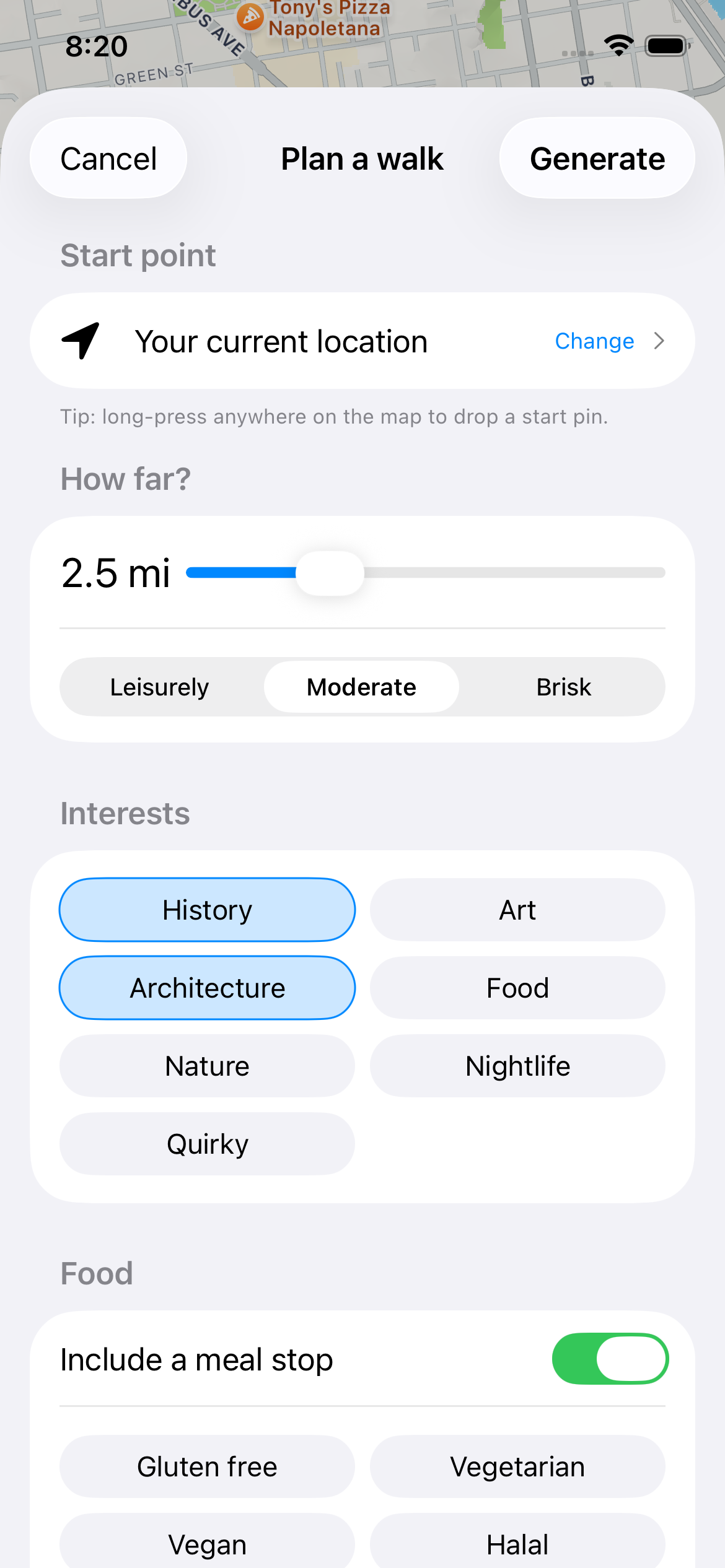
Mosey built this route — download the app to get turn-by-turn audio narration, historic photos, and real-time context at every stop, right in your pocket.
Download on the App Store — FreeMore Austin Walking Tours with Mosey
If the 6th Street Historic District leaves you wanting more Austin history and music culture, the East Austin neighborhood — particularly the stretch along East 11th and 12th Streets — tells the parallel story of Austin's historically Black cultural district, where venues like the Victory Grill hosted national touring acts during the era of segregation and helped define the city's R&B legacy. The Congress Avenue corridor running south from the Capitol offers a companion architecture walk through Austin's Gilded Age government buildings, including the 1888 Texas State Capitol itself. For a completely different register, the South Congress (SoCo) neighborhood captures the Austin bohemian retail and food culture that emerged in the 1990s as an alternative to the downtown strip — Mosey has routes for all of these that pair well with this Sixth Street foundation.