Virginia-Highland takes its name from a street corner. The neighborhood grew up around the crossing of Virginia Avenue and North Highland Avenue in the early twentieth century, when streetcar lines pushed Atlanta's edge northeast of downtown. That origin still shapes the walk: a compact commercial node of low brick storefronts, ringed by residential streets of Craftsman bungalows, Tudor Revival cottages and brick apartment buildings. It is one of the few Atlanta neighborhoods where a self-guided walk works without a car.
This Virginia-Highland walking tour starts at the namesake intersection, drops south along North Highland to one of the city's oldest neighborhood taverns, then loops back north and west through side streets to the edge of Piedmont Park. It finishes at Murphy's on Virginia Avenue, where you can sit down for a proper meal. The route suits anyone interested in food and architecture, since the best buildings here are the everyday ones: porches, gables, rooflines and brick storefronts.
The route was built with the Mosey app, which surfaces historical context as you reach each stop, so you spend less time reading and more time looking up at the rooflines. Your first three Mosey tours are free. Plan for about two and a half hours at an easy pace, including the meal.
The Route: From the Namesake Corner to Piedmont Park and Back
"The neighborhood is named for this intersection, and the name is a relatively modern label for what developers originally sold as separate subdivisions in the early 1900s. Streetcar service was what made the area marketable, because it put the new lots within a commute of downtown Atlanta. In the 1960s and 1970s, residents organized against a proposed freeway that would have cut through the area, and that fight is widely credited with shaping the neighborhood's civic identity. The road that was eventually built, now Freedom Parkway, was a scaled-back alternative."
Stand on the corner and look at the commercial buildings: mostly one- and two-story brick fronts, scaled for walking customers rather than parked cars. Skip trying to find a trace of the streetcar tracks, because there is nothing visible to see. This is a good spot to take a few photos before the sidewalks fill up midday.
"Atkins Park, at 794 North Highland Avenue, dates its operation to 1922 and describes itself as Atlanta's oldest continuously operating neighborhood tavern. Whatever the exact claim, the building belongs to the first wave of commercial construction that followed the streetcar into the neighborhood. Its corner-lot placement is typical of the era, when small taverns and groceries sat at the edge of residential blocks."
Walk south on North Highland to reach it. The exterior and the patio are visible from the sidewalk, so you do not need to go in unless you want a drink. Prices here run to typical restaurant levels, and weekend evenings can be loud and crowded, so a daytime pass-by is the better fit for this route.
"Moe's and Joe's, at 1033 North Highland Avenue, has operated as a neighborhood bar since the late 1940s, making it one of the longer-running businesses on the strip. Its survival is notable in a district where restaurants and shops turn over frequently. The stretch of North Highland around it shows how the commercial blocks filled in over decades, with the older masonry sitting next to later infill."
Walk back north past Virginia Avenue to reach it. It is a quick look from the sidewalk, and it is not a stop to linger at in the middle of the day. Notice how the building rooflines on this block step up and down. The mismatch tells you more about the street's age than any plaque does.
"The residential blocks west of North Highland, along side streets such as Greenwood Avenue and St. Charles Avenue, are where Virginia-Highland's early twentieth-century housing is easiest to read. You will see Craftsman bungalows with deep front porches and tapered columns, Tudor Revival houses with steep gables and decorative half-timbering, and small brick apartment buildings from the same period. These were built as middle-class streetcar housing, and the lots are narrow enough that porches sit close to the sidewalk."
Pick one side street and follow it west rather than trying to cover every block. Look at porch columns, roof brackets and window groupings. They are the quickest way to tell a Craftsman house from a Tudor one. These are private homes, so stay on the sidewalk and keep photos to the exterior.
"Piedmont Park hosted the Cotton States and International Exposition of 1895, a major regional fair that brought exhibition buildings and large crowds to what was then land north of the city. The City of Atlanta later acquired the grounds, and the Olmsted Brothers firm, successors to Frederick Law Olmsted, prepared a plan for the park in the early 1900s. The park's tree canopy and open lawns, and its role as the neighborhood's de facto backyard, trace back to those decisions."
Reach it by heading west toward Park Drive. Entry is free and the park is open daily. Walk in far enough to get a view across the lawns toward the Midtown skyline, then turn back. Skip it on festival weekends if you want quiet, since large events can close paths and fill the surrounding streets.
"Virginia Avenue's commercial blocks near the namesake intersection are a mix of early brick storefronts and later renovations, reflecting the neighborhood's uneven path from streetcar suburb to postwar decline to revival. The neighborhood's preservation-minded civic groups gained strength through the freeway battle, and the surviving bungalows and storefronts are partly the result. Many of the buildings you pass are converted houses and shops, not purpose-built retail."
This is the best stretch for window-browsing, but the independent shops open at different hours, and many do not open until late morning. Treat it as a stroll between the park and lunch rather than a destination. Parking enforcement here is active, so check meter signs if you drove.
"Murphy's, at 997 Virginia Avenue NE, is one of Virginia-Highland's best-known sit-down restaurants and has long been associated with weekend brunch and Southern comfort dishes such as fried chicken and shrimp and grits. It occupies a commercial building on the neighborhood's main corner area, in the same stretch where the walk began. It works as an endpoint because the dining room and patio sit right in the middle of the historic district you just walked."
Weekend brunch typically means a wait, so go on a weekday or arrive before the late-morning rush. Check the current menu and hours before you go, since both change. Budget for a full restaurant meal rather than a quick snack, and expect the patio to be popular on mild days.
Practical Notes Before You Walk Virginia-Highland
Best time to walk: Mid-November in Atlanta is one of the better walking windows: expect cool mornings and mild afternoons, so wear layers you can shed. Leaves are often still turning on the side streets. Summer is hot and humid, so go early. Spring brings heavy pollen. Check the forecast the day before, since Atlanta rain arrives in fast fronts.
Shoes: Mostly sidewalk, but older sections have roots and heaved slabs from the neighborhood's big oaks and pines. Some residential streets rise and fall in gentle grades. Comfortable closed-toe shoes are enough, and you will not need hiking footwear. Watch your footing after leaf fall, when pavement can hide uneven spots.
The narration: At each stop Mosey surfaces the building dates, the people behind the development, and the documented neighborhood events that explain what you are looking at.

Walk Atlanta's Virginia-Highland with Mosey
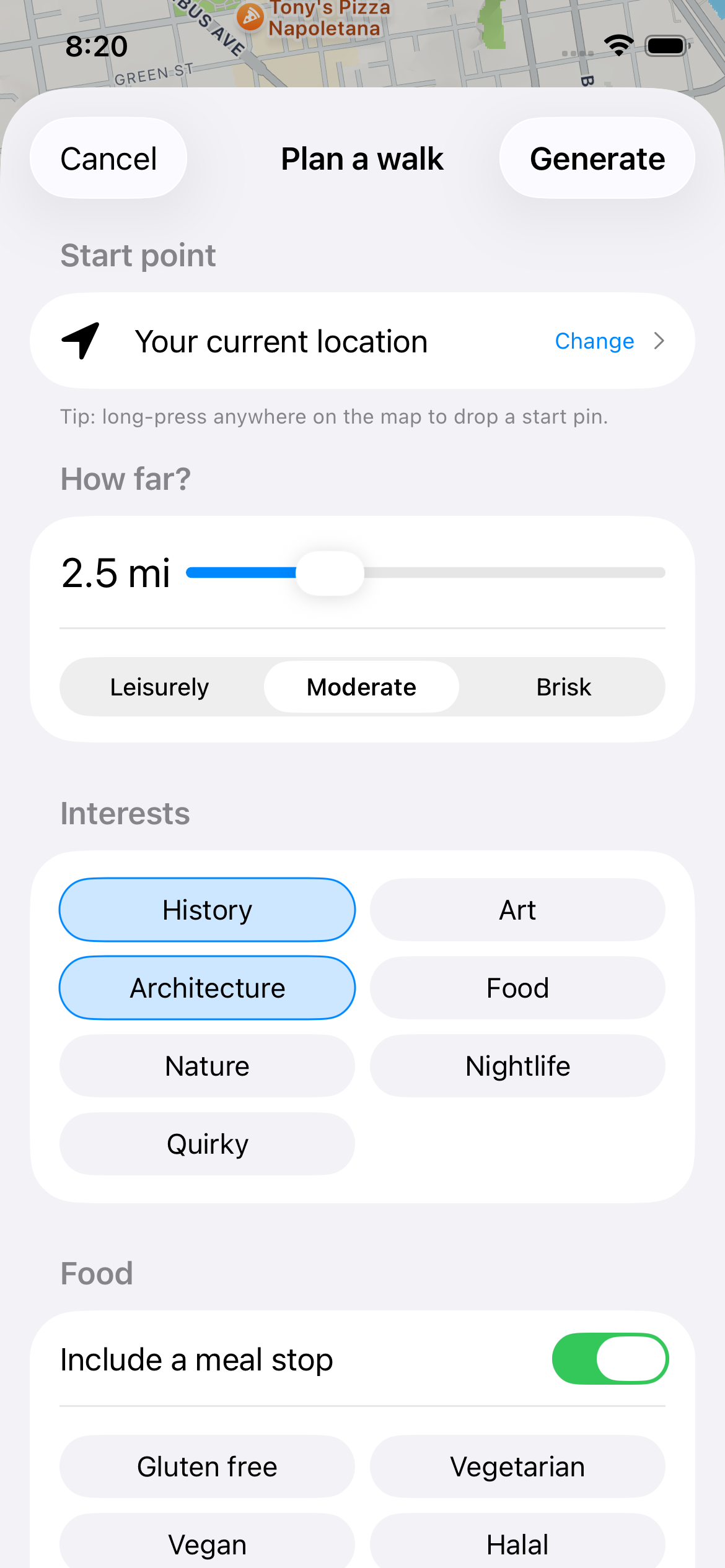
Mosey plans a walk like this one on your iPhone, starting wherever you choose.
- Set a distance or a time and pick what you're into
- Real stops in a walking order that makes sense on foot
- The story behind each stop, read aloud as you arrive
- A meal stop that fits the route

Free to download. iPhone, iOS 17 or later.
Frequently asked questions
How long does it take to walk Virginia-Highland?
The Mosey route takes about two and a half hours at a relaxed pace, including time for photos and a sit-down meal. Walking time alone is closer to an hour. The 2-mile loop is flat to gently rolling, so it suits most fitness levels and can be shortened by skipping Piedmont Park.
Is Virginia-Highland walkable?
Yes, Virginia-Highland is one of Atlanta's more walkable neighborhoods. The shops, taverns and restaurants cluster around Virginia Avenue and North Highland Avenue, with residential streets and Piedmont Park within a short stroll. Sidewalks are mostly continuous, though older sections have roots and uneven slabs, so watch your footing.
Where should I start a self-guided Virginia-Highland tour?
Start at the intersection of Virginia Avenue NE and North Highland Avenue NE, the corner that gave the neighborhood its name. It is the commercial center, with restaurants and shops in every direction. Street parking is limited and metered, so arriving early or taking a rideshare makes the start easier.
What is the best time of day to walk Virginia-Highland?
Morning to early afternoon on a weekday is best. Sidewalks are quieter, shops are opening, and restaurant waits are short. Weekend brunch hours from late morning on are the most crowded, and the strip gets busy again on Friday and Saturday evenings when the bars fill.
Is Virginia-Highland free to explore on foot?
Yes, walking the streets and entering Piedmont Park costs nothing. Your only expenses are food and drink at places like Murphy's. If you use Mosey for the narrated route, your first three tours are free. Parking near Virginia and Highland is metered, so bring a payment method.
Pair This Walk With These Atlanta Neighborhoods
Virginia-Highland connects easily to other Atlanta areas worth walking with Mosey. Poncey-Highland, just south, includes the Ponce City Market building, a former Sears, Roebuck regional distribution center that opened in 1926 and now holds food stalls and shops. Inman Park, further southeast, was developed by Joel Hurt in the 1880s as one of Atlanta's first planned suburbs and has Victorian houses worth a dedicated route. Midtown, on the west side of Piedmont Park, pairs well with a park-focused walk.