Asheville's downtown packs an unlikely amount of architectural ambition into a few blocks — a byproduct of a 1920s building boom that hit its peak right before the Depression flattened the city's finances for decades. That timing accident is why the skyline still reads like a Jazz Age postcard, all Art Deco terra cotta and Gothic spires, largely untouched by the glass-and-steel redevelopment that erased similar districts elsewhere. This walk threads through that preserved core, then drops down toward the French Broad River into the River Arts District, where the city's industrial past — tanneries, warehouses, a cotton mill — has been converted, studio by studio, into one of the Southeast's most concentrated working artist communities.
The route starts at Pack Square, the historic civic heart of the city, and moves through downtown's landmark buildings before heading toward the river along a mix of sidewalks and the Wilma Dykeman Riverway greenway. Expect a shift in texture about halfway through: polished marble lobbies and vertical Deco lettering give way to corrugated metal siding, loading docks repurposed as gallery entrances, and murals covering entire warehouse walls. Both halves reward looking up — at cornices and carved reliefs downtown, at painted facades and studio signage in River Arts.
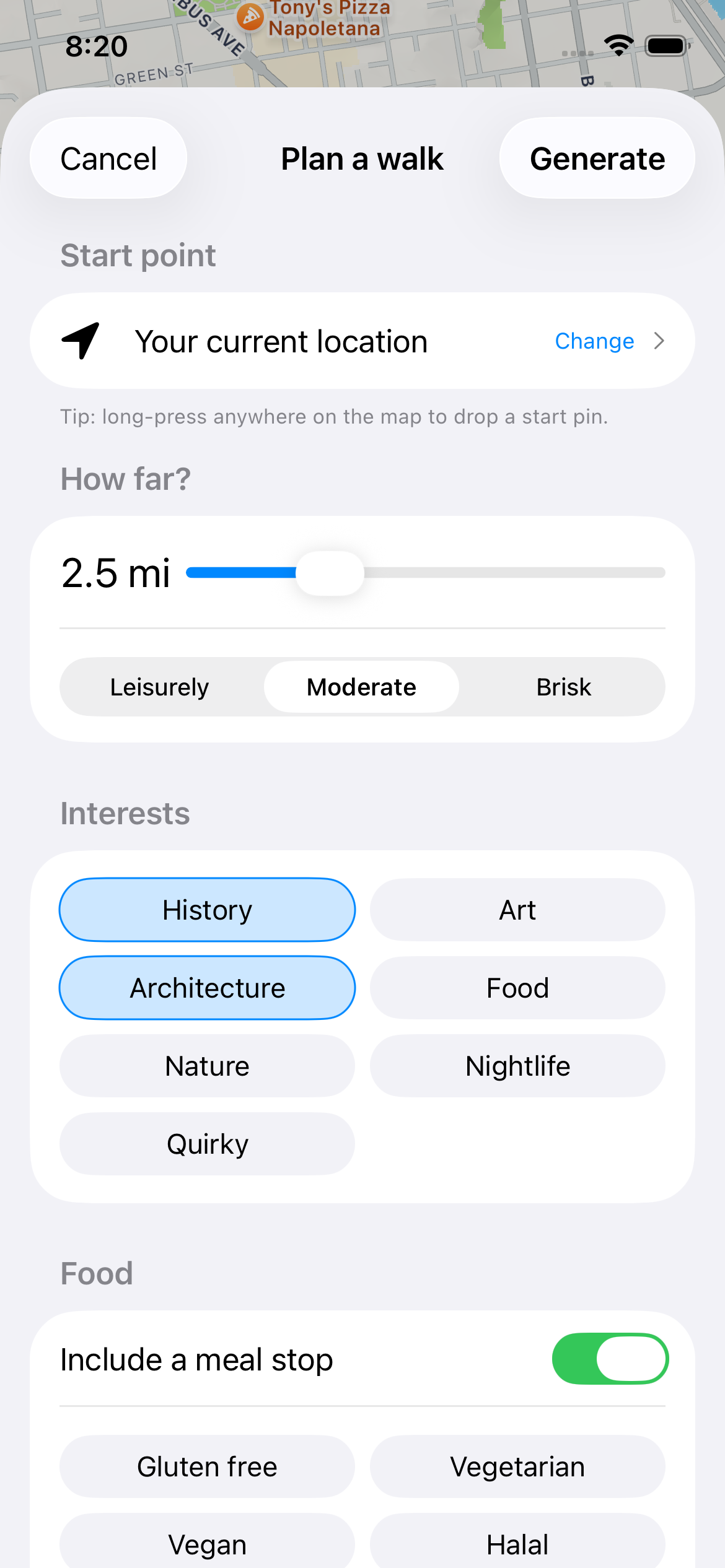
Mosey built this route to connect the two districts logically on foot, with stops chosen for what's actually visible from the sidewalk rather than what's merely famous. At each location, the app surfaces short historical narration — who built it, what it replaced, why it looks the way it does — so you're not standing in front of a building guessing. Pull it up on your phone and let it guide the pacing; you can also just read through the stops below and follow the addresses at your own pace.
The Route: Downtown Landmarks to River Arts Studios
"Pack Square has been Asheville's civic center since George Willis Pack donated the land in 1901, reshaping what had been a cramped courthouse square into an open public plaza. The 75-foot granite obelisk honoring Zebulon Vance stood here from 1897 until its removal in 2021 following years of debate over Vance's history as a slaveholder and Confederate governor. The square is flanked by City Hall and the Buncombe County Courthouse, two buildings that show off Asheville's competing architectural instincts from the 1920s: one flamboyant, one restrained."
Stand near the center of the plaza to see both City Hall's pink-and-green stepped roof and the courthouse's limestone facade in the same sightline. There's no admission fee here — it's a public square, open all hours, and mornings before the heat sets in are the most comfortable time to linger.
"Completed in 1928, City Hall was designed by Douglas Ellington, a North Carolina architect trained in Paris who brought Art Deco sensibilities home and gave them a distinctly local twist. The building's octagonal roof is covered in locally made pink marble and green tile, a deliberate nod to the surrounding Blue Ridge landscape rather than a generic Deco palette. Ellington reportedly clashed with city commissioners over the design's cost and boldness, and the finished building remains one of the most photographed examples of Deco civic architecture in the South."
Walk around to the Court Plaza side for the clearest view of the roofline and stepped massing. The building is a working government office, so interior access is limited to lobby areas during business hours — the exterior is the real draw here.
"Built between 1905 and 1909, this basilica was designed by Rafael Guastavino, the Spanish architect and engineer famous for his self-supporting tile vaulting system — the same technique used in Grand Central Terminal and the Boston Public Library. The church's dome, at roughly 58 feet by 82 feet, is considered the largest freestanding elliptical dome in North America, constructed entirely without internal steel supports. Guastavino settled in Asheville later in life and is buried in a crypt inside the church he designed, alongside his son who continued the family's tile-vaulting business."
Enter from Haywood Street; the interior is open to visitors outside of Mass times, generally daylight hours on weekdays, and there's no admission fee, though donations are welcome. Look straight up at the dome from the center aisle — that unsupported span is the whole point of stopping here.
"Edwin Wiley Grove, the patent-medicine magnate who also built the Grove Park Inn, commissioned this building in 1926 as what he envisioned as the country's first indoor shopping mall, complete with a planned 14-story tower that was never completed due to his death and the Depression. The building's Tudor Revival and Gothic detailing, including gargoyles and carved stone animals along the facade, was meant to evoke European market halls. The federal government took over the building in 1942 and used it for weather forecasting operations during World War II, only returning it to public retail use after a 1990s renovation."
Walk the full interior arcade — it's open daily, free to enter, with local shops and a few food counters. Look for the carved animal reliefs on the exterior facade facing Battery Park Avenue before heading inside.
"The Block was Asheville's historically Black business district, thriving from the late 1800s through the mid-20th century with Black-owned hotels, theaters, and professional offices concentrated along South Market and Eagle streets. The YMI Cultural Center at 39 South Market Street was built in 1892 with funding organized by George Vanderbilt for Black craftsmen who had worked on the Biltmore Estate, giving them a permanent community institution once construction wrapped. Urban renewal projects in the 1970s demolished much of the surrounding district, making the surviving buildings on this block some of the only physical remnants of that era."
The YMI Cultural Center's exterior brick and stone detailing is worth a slow look, and the building operates as a nonprofit cultural space with occasional exhibits open to the public. Check current hours before planning an interior visit, since programming varies.
"This walking and biking corridor is named for Wilma Dykeman, the Asheville-born writer whose 1955 book 'The French Broad' brought national attention to pollution in the river long before environmental writing was mainstream. The greenway roughly traces old industrial rail and road corridors that once served the tanneries, mills, and warehouses that lined the riverbank through the 20th century. Those same industrial buildings, largely abandoned by the 1980s, are what artists began colonizing cheaply in the following decade, eventually forming the River Arts District."
This stretch is functional rather than scenic — a good stop to pick up pace and get water before the art district. There's minimal shade, so this is the section to move through briskly rather than linger.
"The River Arts District occupies a stretch of former tanneries, cotton mills, and warehouse buildings along the French Broad River, industrial structures that sat largely vacant after manufacturing declined mid-century. Artists began renting the cheap warehouse space in the 1990s, and buildings like the old Cotton Mill Studios and the Wedge Building now house dozens of working studios where visitors can watch potters, painters, and sculptors at work rather than just view finished pieces. The district's large-scale murals, many painted directly onto former industrial facades, have become as much a draw as the studios themselves, turning loading docks and blank warehouse walls into a rotating outdoor gallery."
Most studios are open daily but keep varying hours, so weekday mid-morning through early afternoon is the safest window for finding artists actually in their spaces. Entry to studios is free and browsing is expected — no obligation to buy — and the murals along Depot Street and Riverside Drive are worth a slow walk regardless of studio hours.
"12 Bones opened in the River Arts District in 1998, well before the neighborhood's gallery scene took off, and built its reputation on smoked ribs and rotating specialty sides like blueberry-chipotle and jalapeño cheese grits. The restaurant became locally famous partly through word of mouth among river district workers and artists, and partly after a visit from President Obama during a 2013 vacation trip put it on the national radar. It operates out of a converted industrial building consistent with the rest of the district's repurposed warehouse aesthetic."
The current location is at 5 Foundy Street; go early for lunch, since it regularly sells out of popular items and closes once the day's supply runs out. Expect a line at peak hours — outdoor seating overlooks the river, and it's counter service, so order up front and grab a table after.
Planning Your Walk
Best time to walk: Summer in Asheville runs hot and humid by midday, with afternoon thunderstorms common in July. Start this walk by 9:30am to beat both the heat and the crowds downtown, and carry water — there's limited shade along the riverside stretch.
Shoes: Downtown sidewalks are flat and well-maintained; the connector into River Arts includes some uneven pavement and a stretch of greenway path. Comfortable walking shoes are fine — no serious incline, but plan for pavement the whole way.
The narration: At each stop, Mosey surfaces short, sourced historical context — architects, original tenants, and what the building or site looked like before its current use — pulled up automatically as you arrive.
Walk This Route with Mosey
Open the Mosey app to follow this exact route with turn-by-turn guidance and historical narration at every stop, or use it to build your own custom Asheville walking tour.
Download on the App Store — FreeMore Asheville Neighborhoods to Explore
If this route leaves you wanting more, Mosey also maps a Montford Historic District walk through Asheville's largest concentration of Queen Anne and Colonial Revival homes, many built for the professionals who arrived after the Grove Park Inn and Biltmore Estate put the city on the map. The West Asheville corridor along Haywood Road offers a looser, more residential companion to River Arts, with its own cluster of independent galleries, vintage shops, and murals spread along a walkable commercial strip. Both routes are built with the same stop-by-stop historical narration as this one, so you can move between neighborhoods without losing the context that makes the walking worthwhile.