Annapolis packs more surviving colonial and federal-era architecture into its downtown grid than almost any other American city its size. The street plan itself is the artifact: laid out around 1695 by Governor Francis Nicholson using a baroque design of circles and radiating avenues, it still confuses first-time drivers and delights anyone walking it slowly. This is a city where the state capitol predates the federal one, where a working city dock sits two blocks from a functioning legislature, and where brick sidewalks and 18th-century doorways are not staged for tourists but genuinely still in use.
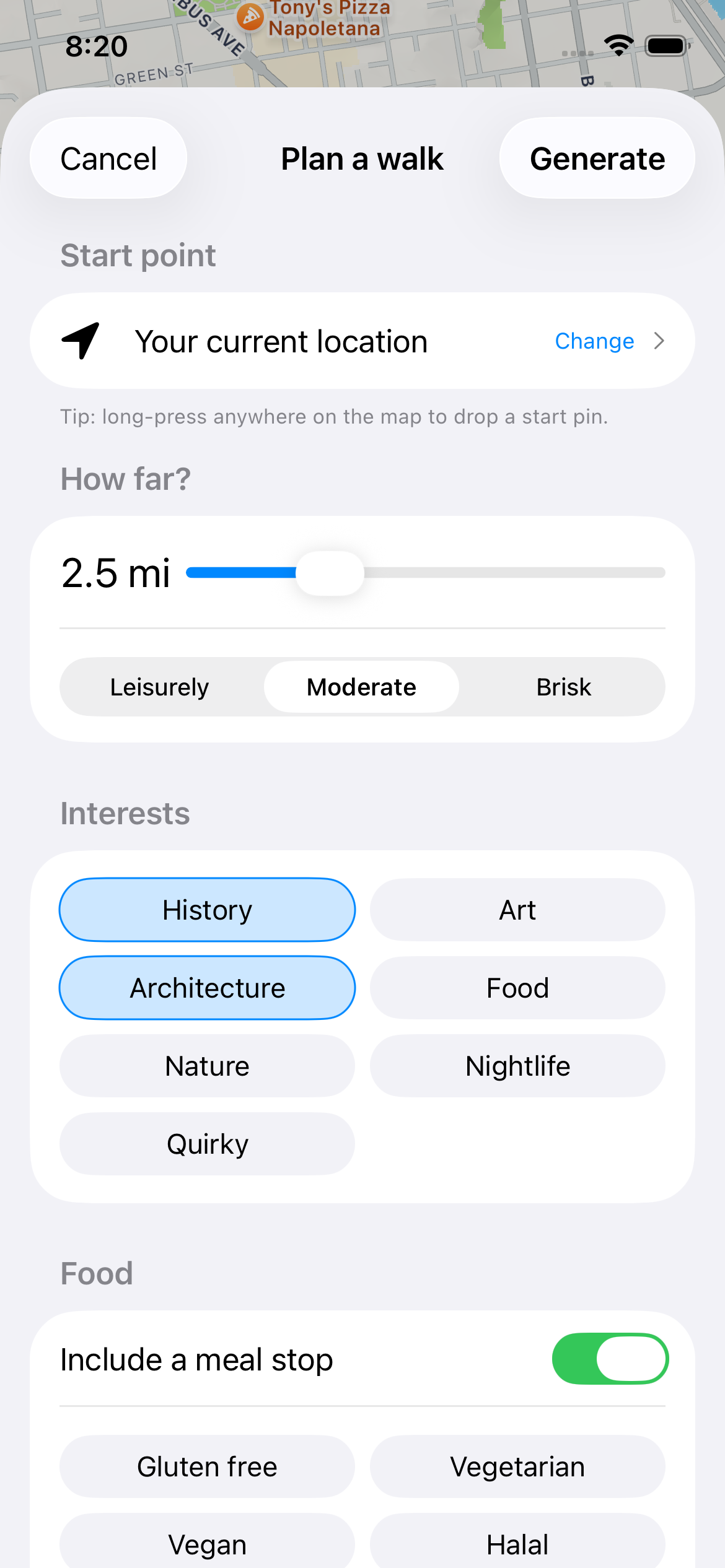
This route starts at the State House, the oldest state capitol still in legislative use, and winds down through the Historic District to the water at City Dock, with a detour past the Naval Academy's main gate before finishing at a diner that's been slinging breakfast to midshipmen and locals since the Truman administration. The Mosey app plots the route with turn-by-turn walking directions and surfaces the historical narration at each stop automatically as you approach, so you're not standing on a corner squinting at a phone screen trying to figure out which building is which.
Expect brick and cobblestone underfoot, real hills (Annapolis is not flat), and a downtown small enough to cover on foot but dense enough that you'll want to stop often. Give yourself a full morning or afternoon rather than trying to rush it before lunch.
The Route: State Circle to City Dock
"Completed in 1779, this is the oldest state capitol in continuous legislative use in the country. The wooden dome, built without a single nail using wooden pegs and iron straps, was designed by Joseph Clark and finished in 1797. George Washington resigned his commission as commander of the Continental Army in the Old Senate Chamber here on December 23, 1783, and the Confederation Congress ratified the Treaty of Paris in the same room in January 1784."
The building is free to enter and self-guided visits are allowed through the visitor entrance on State Circle; bring photo ID for the security check. The Old Senate Chamber is the highlight and takes about ten minutes to see properly. Guided tours run at scheduled times and are worth checking ahead if you want the fuller story.
"This is the third church building on this site at the center of Church Circle; the first two burned down, in 1704 and 1858. The current structure dates to 1859. The churchyard holds the grave of Amos Garrett, Annapolis's first mayor, and a communion silver set given by King William III in 1695 is still part of the parish's collection."
Peek into the churchyard even if you don't go inside — the older headstones are worth a slow look. The church sits directly on Church Circle, one of Nicholson's original 1695 traffic circles, so take a second to notice how the streets radiate outward from this spot.
"Built in 1774 for planter Matthias Hammond, this Georgian house is attributed to architect William Buckland, who also worked on the Chase-Lloyd House across the street before his death in 1774 left this project his last documented commission. The carved doorway is considered one of the finest examples of colonial woodwork in the country. It's one of the only pre-Revolutionary houses in America still standing with its original outbuildings intact on the same lot."
Interior tours are paid and run on a set schedule seasonally, so check hours before you plan around it. Even without going in, the exterior doorway on Maryland Avenue is worth stopping for on its own — it's a five-minute look that photographs better in late morning light.
"The Naval Academy was founded in 1845 by Secretary of the Navy George Bancroft on the site of a former Army post, Fort Severn. Today the campus, known as the Yard, covers roughly 338 acres along the Severn River. Visitors without a Department of Defense ID must enter through the Visitor Entrance and pass a security check; the Armel-Leftwich Visitor Center just inside sells tickets for walking tours led by Academy-trained guides."
You'll need government-issued photo ID to pass security, and vehicle access is separate from pedestrian access. If you don't want to go through security, it's still worth walking up to the gate to see the scale of the place and the Bancroft Hall dome in the distance. Guided walking tours inside cost around $16 for adults as of recent seasons and last about an hour.
"A public market has operated on this spot since 1784, making it one of the oldest continuously used market sites in the country, though the current building dates to 1858 with later renovations. City Dock itself sits at the head of Spa Creek and was the working port where tobacco, and later immigrants and enslaved people, moved through colonial Annapolis. Alex Haley's novel Roots identifies this dock as the point where his ancestor Kunta Kinte arrived in 1767, and a memorial to Haley and Kinte stands at the water's edge."
Walk down to the Kunta Kinte-Alex Haley Memorial at the dock's edge before heading to lunch — it's a two-minute stop and easy to miss if you're focused on the boats. The market building now houses food vendors, useful if you want a snack before the main meal stop.
"Opened in 1965 by Chick and Ruth Levitt, this diner at 165 Main Street has been a fixture of Annapolis politics and Naval Academy life for close to sixty years. Every morning at 8:30 on weekdays (9:30 on weekends), the whole restaurant stops to recite the Pledge of Allegiance, a tradition the Levitt family started decades ago that continues under current ownership. The menu runs to sandwiches named after Maryland politicians, including the Colossal Fossil milkshake and a lineup of governor-named platters."
Go for breakfast if your schedule allows it — the pledge recitation is the thing people remember, and it happens rain or shine, tourists or not. It's small and fills up fast on weekends, so expect a short wait around midday. Cash and card both work; portions are large enough to split.
Planning Notes for Walking Annapolis
Best time to walk: September afternoons in Annapolis run warm and humid, often in the low 80s, with brick sidewalks holding heat. Mornings are cooler and less crowded, especially around City Dock. Bring water; shade is scarce on State Circle.
Shoes: Brick and cobblestone sidewalks throughout, plus a real hill between State Circle and the water. Flat, closed-toe shoes hold up far better here than sandals.
The narration: Mosey surfaces the specific year, architect, or documented event tied to each stop as you arrive, rather than generic historical color.
Walk Annapolis with Mosey
Open the route in the Mosey app for turn-by-turn directions and the full historical narration at every stop, timed to when you actually arrive.
Download on the App Store — FreeFrequently asked questions
How long does it take to walk the Annapolis Historic District?
Plan on two to three hours for a relaxed pace covering the main sites: State House, Church Circle, Maryland Avenue, the Naval Academy gate, and City Dock. Add 30–45 minutes if you go inside the Hammond-Harwood House or take a guided Naval Academy tour. The core loop is under two miles, but hills and brick sidewalks slow foot traffic down.
Is the Annapolis Historic District walkable?
Yes, and it's better on foot than by car. Streets radiate from two colonial-era circles with narrow lanes and limited, expensive parking, so a car is often a liability downtown. Brick and cobblestone sidewalks are uneven in places, and there's a real hill between State Circle and City Dock, so wear flat shoes.
Do I need a ticket to see the Maryland State House?
No ticket is required for self-guided visits; entry is free through the visitor entrance on State Circle. You'll need photo ID for a security screening. Guided tours run on a set schedule and are also free, but check the State House website for current times since hours shift seasonally and around legislative session.
Can you just walk into the Naval Academy?
Visitors without military ID must enter through the Visitor Entrance (Gate 1) and pass a security check with government-issued photo ID; vehicles need a separate pass. Once inside, the Yard is open to walk, and the visitor center sells guided walking tours for around $16 for adults, typically lasting about an hour.
What is the best time of day to walk Annapolis's Historic District?
Morning, roughly 9 to 11 a.m., before tour buses and cruise-in crowds hit City Dock. September mornings run cool and clear, and the State House and Naval Academy gate are both less crowded early. Late afternoon works too, especially for photos of the State House dome in low light.
Is Chick & Ruth's Delly worth the wait?
Yes, especially for the 8:30 a.m. weekday (9:30 weekend) Pledge of Allegiance tradition that's run since the 1960s. It's a small diner at 165 Main Street, so weekend lunch waits can run 20–30 minutes. Portions are large — the milkshakes and named sandwich platters are easily shared between two people.
Other Walks Worth Building
Annapolis rewards a second walk if you have the time. The Eastport neighborhood, across the Spa Creek drawbridge from City Dock, has its own working-waterfront character and a different pace worth building as a separate Mosey route. West Street, running from Church Circle out toward the county courthouse, holds a denser concentration of restaurants and galleries than the core historic blocks and makes a good food-focused follow-up walk. If Colonial history is the draw, Mosey's Alexandria, Virginia and Philadelphia Old City guides cover similar ground from different angles of the same period.