Downtown Ann Arbor is a college town core that never fully surrendered to the university surrounding it. Main Street still runs on a grid platted in 1824, the storefronts are mostly 19th-century brick, and the whole district sits on a scale you can cover on foot without much effort. This isn't a campus tour — you won't set foot on University of Michigan property here — it's the commercial and civic downtown that grew up alongside the school, with courthouses, breweries-turned-shops, and a farmers market that's been running continuously since 1919.
The route starts near the old Washtenaw County Courthouse area, works through Main Street's historic commercial strip, cuts up to the Michigan Theater, and finishes in Kerrytown, the market district on the north edge of downtown. Along the way you'll pass building facades with dates still cut into their stone, a courthouse square, and one of the country's better-known delicatessens. It's a walk that rewards looking up — a lot of downtown Ann Arbor's history is on the upper floors and cornices, not at street level.
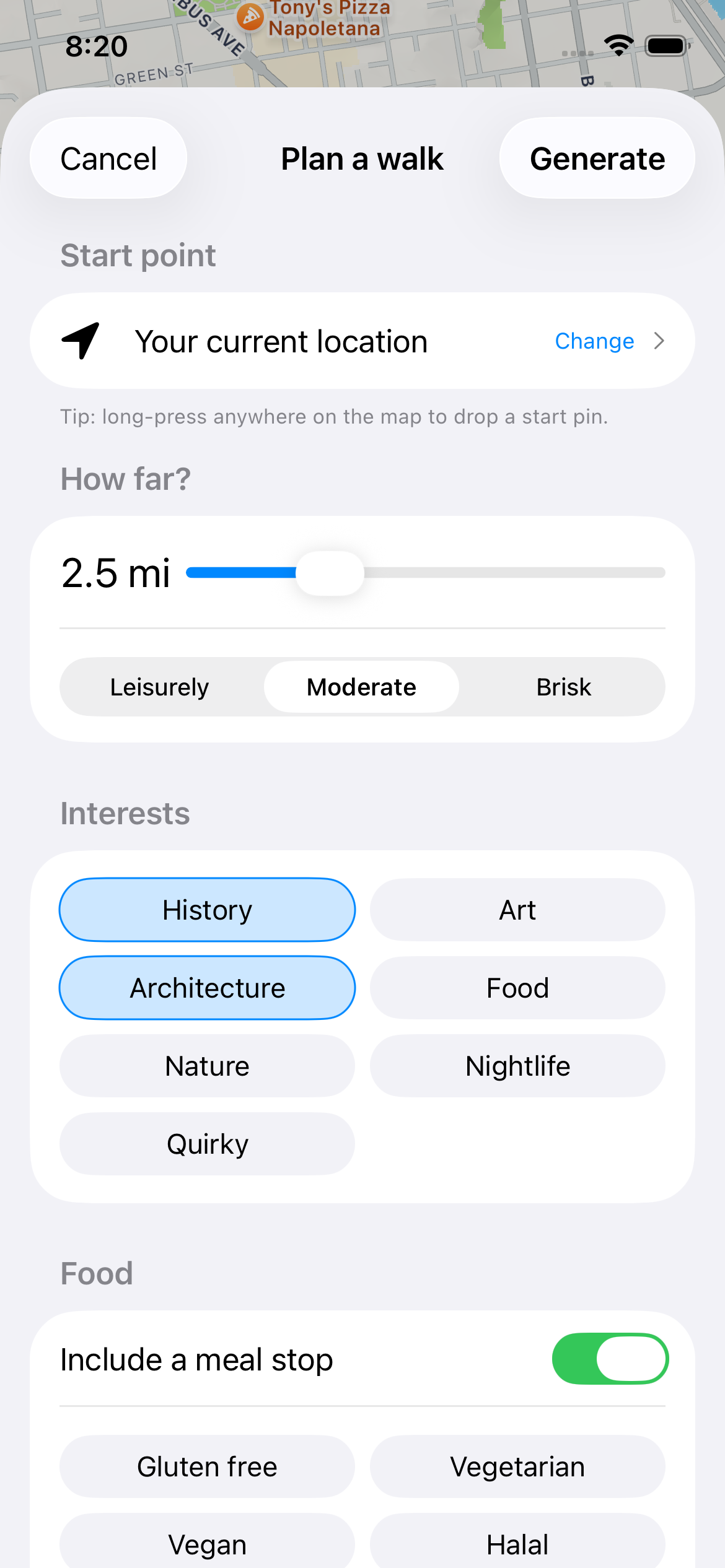
Mosey lays out the stop order and the walking lines between them, so you're not stopping to check a map every block. At each location it surfaces the kind of context in this guide — who built what, when, and why it still matters — so you can just look at the building instead of your phone.
The Route: Courthouse to Kerrytown
"The current courthouse at 101 E. Huron St was built in 1955, replacing an 1877 Italianate courthouse that stood on the same site and burned down under mysterious circumstances after the county board voted to raze it. The original 1877 building was demolished by fire in 1954, just months after that vote, and the replacement went up in 1955. This block has served as the county's civic anchor since Washtenaw County was organized in 1826."
There's not much to see architecturally — it's a mid-century civic building — but it's worth a two-minute stop for the history of what stood here before. Look for the historical marker near the entrance describing the earlier courthouse.
"Main Street between Huron and William was built up mostly between 1860 and 1915, after a series of fires pushed the city toward brick and stone construction codes. Many of the buildings still carry their original cornices and painted dates — the 1881 Hutzel Building and the 1860s-era blocks near Main and Washington are among the oldest survivors. This stretch was Ann Arbor's primary retail and banking corridor well before the university's north campus existed, serving a town that was still built around farming and rail traffic through the late 1800s."
Walk the west side of Main Street between Huron and Liberty and look up above the storefronts — the ground floors have been renovated repeatedly, but the upper facades keep their original brick and stone detail. Zingerman's Deli sign era aside, this is the best block for spotting carved building names and dates.
"The Michigan Theater opened on January 5, 1928, built by local jeweler Angelo Poulos to compete with the Majestic and Wuerth theaters downtown. It was designed by the Chicago architecture firm Maurice Finkel in a French Renaissance style with a Barton pipe organ, one of the few original theater organs of that era still functioning and used regularly. The theater survived the multiplex era and near-demolition threats in the 1970s largely because a nonprofit formed in 1979 to take it over and restore it."
You can usually step into the lobby during box office hours (typically opening an hour before showtimes) even if you're not seeing a film. If there's a matinee or organ demonstration listed that day, it's worth timing your walk around it — check michtheater.org before you go, since hours vary by day.
"The State Theatre at 233 S. State St opened in 1942, designed by architect C. Howard Crane, who also designed Detroit's Fox Theatre. Its Art Deco marquee and neon vertical sign are largely original to the 1940s build, making it one of the more intact period movie theater exteriors left in downtown Ann Arbor. It operated as a movie house for decades before being redeveloped, with the theater space itself converted for retail while the historic facade was preserved."
This is a quick photo stop rather than a place you go inside — the marquee and vertical neon sign are the draw. Best seen from across State Street where you can get the full facade in frame.
"Nickels Arcade was built in 1915 by Tom Nickels, modeled loosely on European shopping arcades and Chicago's covered passages of the era. It runs between State Street and Maynard Street with a barrel-vaulted glass skylight roof that still lets natural light into the corridor, unusual for a structure of this age still in commercial use. It's one of the only surviving arcade-style retail buildings of its kind in Michigan."
Walk the full length of the arcade rather than just glancing in from State Street — the skylight and the narrow storefronts on either side are the whole point. A few small, independent shops here have been in the arcade for decades, worth a look even if you're not buying anything.
"Kerrytown takes its name from an early Irish immigrant enclave in this part of town, and it's anchored by the Ann Arbor Farmers Market, which has operated at its current Detroit Street location since 1919, making it one of the oldest continuously running farmers markets in Michigan. The Kerrytown Market & Shops building at 407 N. Fifth Ave, opened in 1982, was built by developer Joe O'Neal partly around a former pickle factory structure, repurposing the old industrial building rather than clearing it."
The farmers market itself runs Saturdays year-round and Wednesdays May through December, so if your walk falls on another day you'll see the district quieter but still worth the stop for the buildings. Late morning Saturday is the liveliest time to pass through.
"The streets just north and east of the market, including sections of Fourth and Fifth Avenues, hold a cluster of mid-to-late 19th century worker's cottages and Greek Revival houses built for the tradespeople and market vendors who worked this district before it was formally a commercial zone. Several date to the 1840s-1860s, making them older than most of downtown's commercial buildings a few blocks south."
This is a short detour rather than a formal stop — walk a block or two off the main market street to see the house scale change from commercial brick to small wood-frame homes. Don't linger too long here; it's residential, and the real destination is back toward Main Street for the meal stop.
"Zingerman's opened in 1982 at 422 Detroit St, founded by Paul Saginaw and Ari Weinzweig in a building that had housed a grocery store since 1902. What started as a small corner deli has grown into a nationally known food business, but the original Detroit Street location still operates as a full delicatessen with a menu built around house-cured meats, imported cheeses, and a bread program run out of their own bakehouse a few blocks away. It's one of the most cited examples nationally of a small deli scaling into a large regional food business without leaving its original storefront."
Expect a line, especially on weekends — it moves fast, but budget extra time. Sandwiches run $16-19, which is high for a deli, but portions are large enough to split. The Reuben and the #2 (corned beef) are the most ordered items; grab a seat at the counter if the small dining room is full, or take it to go and eat in the Kerrytown courtyard nearby.
Planning Your Walk
Best time to walk: September in Ann Arbor is generally mild, in the 60s and 70s°F, but afternoon storms roll through often enough to bring a light layer. Early September also overlaps with the start of the U-M fall semester, so downtown sidewalks and restaurants get busier once students move back in.
Shoes: Flat sidewalks and brick crosswalks throughout; comfortable walking shoes are enough, no serious terrain to worry about.
The narration: Mosey pulls up the building date, architect, or founding story right as you arrive at each stop, so the history lines up with what's actually in front of you.
Walk Downtown Ann Arbor with Mosey
Get turn-by-turn walking directions and on-site historical narration for every stop on this route, right in the Mosey app.
Download on the App Store — FreeFrequently asked questions
How long does it take to walk Downtown Ann Arbor?
Budget about 2 to 2.5 hours for the full 1.8-mile route with stops. The walking time alone is closer to 35-40 minutes, but the Michigan Theater, Nickels Arcade, and Zingerman's are worth lingering at, and the farmers market can easily add 20 more minutes if it's open.
Is Downtown Ann Arbor walkable?
Yes. Downtown Ann Arbor is a compact grid with wide sidewalks, marked crosswalks, and short blocks between Main Street, State Street, and Kerrytown. Almost everything on this route is flat, and street parking or the Fourth & William structure puts you within a few blocks of the whole loop.
Is this walking tour different from a University of Michigan campus tour?
Yes, this route stays entirely off campus. It covers the city's commercial downtown — Main Street, the Michigan and State Theatres, Nickels Arcade, and Kerrytown — rather than U-M's Central Campus, which sits a few blocks east and is typically covered by a separate campus-focused walk.
What's the best time of day to walk Downtown Ann Arbor?
Late morning to early afternoon works best, especially on a Saturday when the Kerrytown Farmers Market is running. Weekday mornings are quieter and better for photos of the Main Street facades, but you'll miss the market energy and some shops open later, around 10 or 11 a.m.
Do I need to book anything in advance for this route?
No advance booking is required for any stop on this route. The Michigan Theater lobby, Nickels Arcade, and Kerrytown are all free to walk through. Zingerman's Deli doesn't take reservations for regular counter service, so arrive slightly before or after the noon rush to avoid the longest line.
Is Downtown Ann Arbor safe to walk at night?
Generally yes, particularly on Main Street and State Street where foot traffic and lighting are consistent into the evening due to bars, theaters, and restaurants. Kerrytown quiets down earlier since it's market-focused rather than nightlife-focused, so it's better walked in daylight hours.
More Ann Arbor Walks on Mosey
If Downtown leaves you wanting more of Ann Arbor, Mosey also maps a University of Michigan Central Campus route covering the Diag, the Law Quad, and the Burton Memorial Tower, plus a Kerrytown-to-Old West Side extension for anyone who wants to see the Victorian residential streets west of Main Street. Both connect naturally to this walk if you've got the afternoon for it.