Old Town Alexandria is one of the few places on the East Coast where the street grid, the building stock, and the water are all still doing roughly what they did in the 18th century. The town was surveyed in 1749, laid out on a grid by a young George West with help from a 17-year-old assistant surveyor named George Washington, and it grew fast as a tobacco port. Because Alexandria stayed a working port and trading town rather than getting swallowed into industrial redevelopment, a lot of the brick and stone from the Federal and colonial periods survived intact, which is why the architecture here reads less like a museum reconstruction and more like a place people never stopped living in.
This route runs from the Ramsay House visitor center down through the historic core to the waterfront, tracing the original commercial spine of King Street before cutting over to the residential blocks with their brick rowhouses and hidden gardens. You'll pass a tavern where Washington recruited militia, a church he attended, and houses built by merchants who made their money off the same river you'll be looking at. It's flat, it's compact, and almost none of it requires stepping off a sidewalk onto anything but brick.
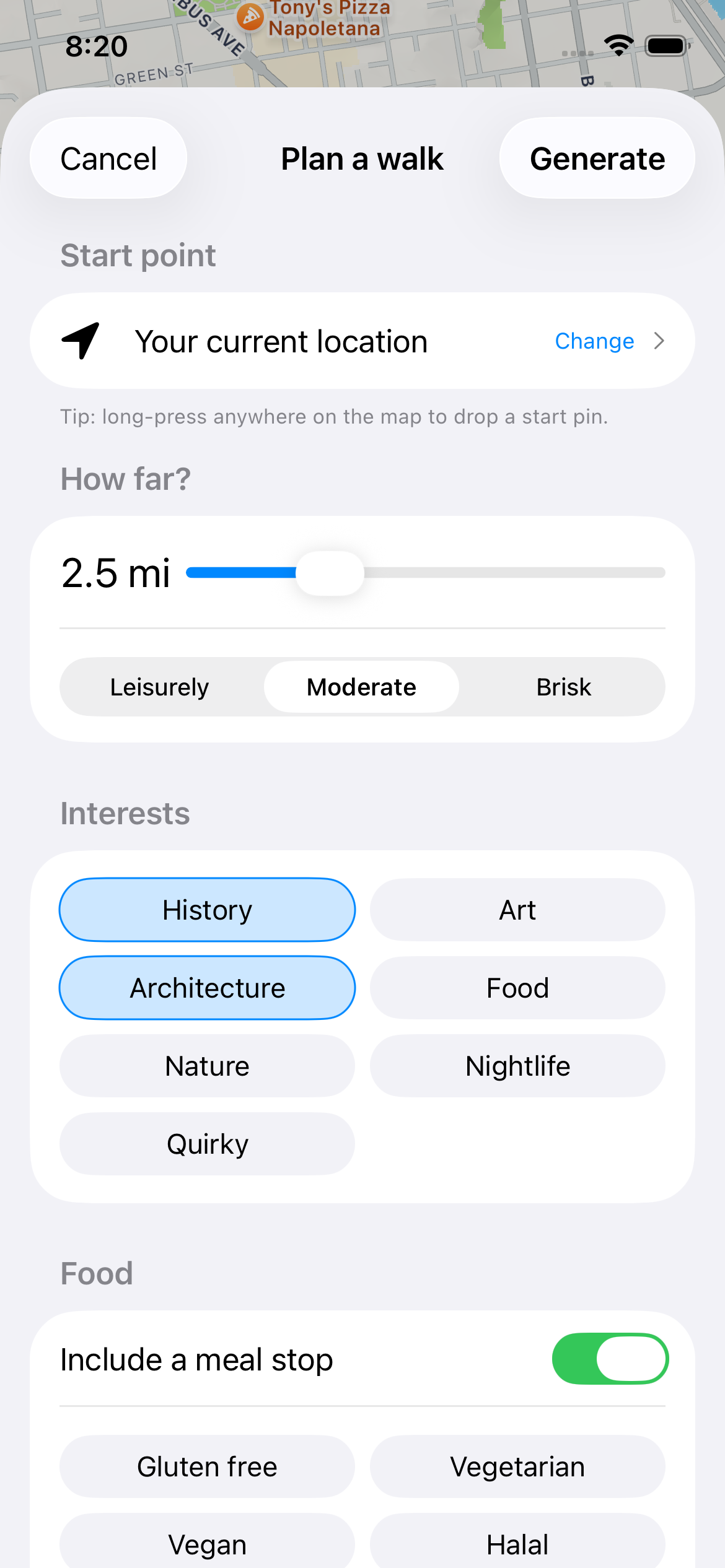
Mosey built this walk stop-by-stop so you're not toggling between a map and a guidebook — each location on the route surfaces its own history right when you're standing in front of it. Pull it up on your phone, follow the route, and read the context as you go instead of before or after.
The Route: King Street to the Waterfront
"Ramsay House sits on the lot deeded to Scottish merchant William Ramsay, one of Alexandria's founding trustees in 1749, though the current building dates to a later period and was substantially rebuilt in the 20th century after fire damage. Ramsay was a business partner of the Fairfax and Carlyle families and one of the men who petitioned Virginia's legislature to establish the town in the first place. The building now serves as Alexandria's official visitor center, run by Visit Alexandria."
Stop inside for a free paper map and to check the hours for paid sites you'll pass later, like Gadsby's Tavern Museum. There's no admission fee here, and it's a good five-minute orientation stop before you start walking.
"Gadsby's Tavern Museum at 134 N. Royal St. comprises two buildings, a 1785 tavern and an 1792 hotel addition, both operated by English innkeeper John Gadsby from 1796 to 1808. George Washington celebrated his birthday here in 1798 and 1799, and the tavern hosted Thomas Jefferson's presidential campaign dinner in 1800. The ballroom's musicians' gallery and the second-floor assembly room are original 18th-century construction, restored using period paint analysis."
Admission is $7 for adults as of recent pricing, and the museum is closed Mondays and Tuesdays — check before you plan around it. If it's closed, you can still see the exterior and the connected restaurant next door, which occupies part of the original tavern building.
"Market Square has functioned as a public marketplace since the town's founding in 1749, making it one of the oldest continuously operating farmers markets in the country. The current Alexandria City Hall, facing the square, was built in 1873 after fire destroyed the earlier 1817 town hall on the same site. The square itself was also used historically for military musters and public announcements, given its central position on the original town plan."
If you're walking on a Saturday morning, the farmers market runs here from 7 to 11 a.m. and is worth timing your walk around. Otherwise the square is just a good spot to look at City Hall's Victorian facade against the older colonial-era buildings surrounding it.
"Carlyle House at 121 N. Fairfax St. was built in 1753 by Scottish merchant John Carlyle, one of Alexandria's founders, using sandstone quarried from Aquia Creek. In April 1755, British General Edward Braddock met here with five colonial governors to plan strategy and funding for the French and Indian War, a meeting now considered a direct precursor to the American Revolution's tax disputes since the colonies balked at footing the bill. The house is one of the few surviving examples of Georgian Palladian architecture in Alexandria built directly for a private merchant."
Admission runs a few dollars for a guided tour, and the tours are the only way to see the interior, so check the posted schedule if you want to go in. The garden behind the house is free to walk through and gives you a clear look at the stone construction from the rear.
"Christ Church at 118 N. Washington St. was completed in 1773, built of brick in a Georgian style, with a boxed pew still marked as George Washington's family pew. Robert E. Lee was confirmed here in 1853, and the church has held continuous Episcopal services since its construction. The interior retains its original wine-glass pulpit and Palladian window over the altar, both rare survivals from the colonial period."
The church is free to enter during open hours, typically weekdays and Sunday afternoons outside of services, and it's worth the few minutes to see the box pews up close. Go quietly if a service or wedding is in progress, which happens fairly often.
"The Torpedo Factory at 105 N. Union St. was built in 1918 as the U.S. Naval Torpedo Station, manufacturing torpedoes through both World Wars before the building was decommissioned and converted into artist studios starting in 1974. Today it houses roughly 82 working studios and galleries across three floors, making it one of the largest working artist communities of its kind on the East Coast. The waterfront itself was Alexandria's original economic engine, a deepwater port that shipped tobacco, flour, and later, in a grimmer chapter, enslaved people sold through the domestic slave trade in the early 19th century."
The art center is free to walk through, and most studios let you watch artists working at their tables. Afterward, walk out to the Potomac riverwalk behind the building for open water views and benches, a good spot to sit for a few minutes before the last stop.
"The Fish Market at 105 King St. has operated in the same building since 1976, in a structure dating to 1805 that once served as a warehouse tied to Alexandria's shipping trade. It's one of the longer-running restaurants on King Street, known for its raw bar, crab cakes, and exposed brick dining rooms across multiple connected floors. The building's ship-lap paneling and low ceilings on the upper level are original to its warehouse-era construction."
Go for the crab cakes or the oyster stew, and expect a wait on weekend evenings since it doesn't take reservations for smaller parties. Lunch is quieter and cheaper than dinner, and the upstairs dining rooms have more of the original exposed timber if you ask to be seated there.
Planning Your Walk
Best time to walk: September in Alexandria runs warm and humid at midday, with highs still near 80°F, so an early morning or late afternoon start is more comfortable. Brick sidewalks hold heat, and there's limited shade on the waterfront blocks.
Shoes: Flat brick and cobblestone sidewalks throughout, with a few uneven stretches near the 18th-century blocks — comfortable flat shoes are more useful here than anything with a stiff sole.
The narration: Mosey surfaces the specific year, builder, or documented event tied to each address as you arrive, rather than general neighborhood background.
Walk Old Town Alexandria with Mosey
Get turn-by-turn guidance and on-site history for every stop on this route, right on your phone, so you can look at the buildings instead of your map.
Download on the App Store — FreeFrequently asked questions
How long does it take to walk Old Town Alexandria?
Plan on roughly two to two and a half hours to cover the two-mile core route at a comfortable pace, including stops at Gadsby's Tavern, Carlyle House, and the waterfront. Add 30 to 45 minutes if you go inside any paid museums, and more if you stop for a full meal on King Street.
Is Old Town Alexandria walkable without a car?
Yes. Old Town's colonial-era grid is flat, compact, and built on a pedestrian scale, with brick sidewalks connecting nearly every historic site within about a mile of the waterfront. The King Street Metro station and a free King Street Trolley (seasonal) both cut down on walking if needed, but most visitors don't need either.
What is the best time of day to walk Old Town Alexandria?
Morning, roughly 9 to 11 a.m., is best for cooler temperatures, easier parking, and quieter photos at Market Square and Christ Church. Late afternoon into early evening works well too, especially for finishing the walk at a King Street restaurant around sunset over the Potomac.
Are the historic houses in Old Town Alexandria worth paying to enter?
Carlyle House and Gadsby's Tavern Museum are both worth the admission, generally $5 to $8, for their documented Revolutionary War-era history and original 18th-century interiors. If you're short on time or budget, the exteriors and free sites like Christ Church and Market Square still carry most of the neighborhood's historical weight.
What should I skip if I only have one hour in Old Town Alexandria?
Skip the guided house tours, which run 30 to 45 minutes each, and instead walk King Street from the waterfront to Market Square, glancing into Gadsby's Tavern and Christ Church from the outside. You'll still see the core architecture and get a sense of the colonial street grid in under an hour.
Is Old Town Alexandria safe to walk at night?
Yes, the historic core along King Street and the waterfront is well-lit, heavily trafficked by restaurant-goers, and generally considered safe for evening walks. As with any city, stick to the main lit streets rather than quieter residential side streets late at night, and standard urban awareness applies.